Chitika

Showing posts with label Compare Smartphone. Show all posts

Friday, April 5, 2013

Best budget Android phones: review roundup

High-spec, high-price smartphones might be what get us excited, but the real work is being done at the budget end of the Android market, with workhorse devices that make the daily business of organising our lives, entertaining us and keeping in touch seem easy and hassle-free. Top tier technology is steadily trickling down to the lower price points too, sometimes in less than a year, making this an increasingly competitive area, and harder than ever to tell the crackers from the squibs. Here are a few of the best budget Android devices that have come across our desk in the last few months.

Huawei Ascend G300

Chinese manufacturer Huawei made quite a splash with the G300 last year and it still takes some beating, with its large, sharp four-inch screen sitting securely behind tough Gorilla Glass and a fast, capable 1GHz processor backed by 512MB RAM. It's got a fair quality five-megapixel camera with autofocus that starts up impressively quickly, making it ideal for quick snaps. The metal casing is nice to see at this level. While it's no great looker, and with Gingerbread starting to look a bit old now, for the price, this is a cracking little device from a brand that's getting serious about smartphones.

Specifications
Software: Android 2.3.6 Gingerbread
Processor: 1GHz
Display: 4in 800x480 pixels
Camera: 5 megapixel
Size: 123x63x11mm
Weight: 140g
Wired: 4in screen, 1GHz processor, good spec for the price
Tired: Camera lacks features and could be better quality
Score: 8

Sony Xperia Tipo


The Xperia Tipo may not be a world-beater in terms of spec, but it's excellent value for the sub-£100 price. Its bijou 3.2-inch screen offers a so-so resolution of 480x320 pixels. It has a 3.2-megapixel camera, which doesn't look great on paper, but this being Sony the snaps are a cut above some of its similarly specced rivals from HTC and others. The 800MHz processor does a decent enough job too, but this is just about the cheapest handset we've yet seen that comes with Android 4.0 Ice Cream Sandwich out of the box -- smoother, more intuitive and generally nicer to use, it's a serious step up from Gingerbread.

Specifications
Price: £70
Software: Android 4.0 Ice Cream Sandwich
Processor: 800MHz
Display: 3.2in 480x320 pixels
Camera: 3.2 megapixel
Size: 103x57x13mm
Weight: 99g
Wired: Basic but solidly built, okay camera
Tired: Screen not very sensitive
Score: 6

HTC Desire C


HTC Desire has been a smartphone powerhouse in recent years, churning out all sorts of variations on the theme. The Desire C is the cheapest one they do, but still manages to pack in a decent spec, with Ice Cream Sandwich on board from the off, good-sized 3.5-inch screen and a pretty decent five-megapixel camera. The 600MHz processor is a bit too low-powered to impress, though HTC has pared back the Sense interface to make it a bit smoother -- apps can still take a while to load up though and the fancier games won't be seen at their best. It's got typical HFC high build quality and NFC's on board for wireless payments and quick-change settings if you're keen to use the latest thing,

Specifications
Price: £100
Software: Android 4.0 Ice Cream Sandwich
Processor: 600MHz
Display: 3.5in 320x480 pixels
Camera: 5 megapixel
Size: 107x61x12mm
Weight: 98g
Wired: Android 4.0 Ice Cream Sandwich, HTC Sense 4.0, decent camera
Tired: Slow processor, unresponsive screen
Score: 7


Acer Liquid Glow


Debuting with Ice Cream Sandwich, the Liquid Glow has the power to back it up with a 1GHz processor and 512MB RAM that helps make navigation and use smooth'n'easy, whatever you're doing. The large 3.7-inch screen offers a sharper than usual resolution of 800x480 pixels -- one of the best you'll see at this price point, and all the better for watching movies or for showing off the pics from the really rather good five-megapixel camera. There's no front-facing camera for video calls, but its sleek, tactile casing is a joy to hold.

Specifications
Price: £130
Software: Android 4.0.4 Ice Cream Sandwich
Processor: 1GHz
Display: 3.7in 480x800 pixels
Camera: 5 megapixel
Size: 117x59x12mm
Weight: 125g
Wired: Good spec for the price, Ice Cream Sandwich, solid build
Tired: No front-facing camera
Score: 7

Wednesday, April 3, 2013

7 best smartphones to consider now

If you're ready to drop some money on one of the latest and greatest smartphones, you have some great choices — too many, in fact.

Turbocharged quad-core processors and wireless charging have nearly become standard on top-of-the-line Android phones. As always, the latest iPhone and its gorgeous screen and vast ecosystem of content is worth your consideration. For those looking to break free of iOS or Android altogether, the underrated Windows Phone 8 awaits.

How can you possibly decide? I've rounded up the 7 best smartphones available and I'll tell you what makes them good.

HTC One
Honed from a slab of aluminum, this 4G LTE flagship from HTC wows on looks and specs. It features a high-resolution 4.7-inch screen, 32 or 64 GB of storage, and is powered by a quad-core processor.


htc-soft2

HTC also worked hard on customizing the latest version of the Android operating system, Jelly Bean. The BlinkFeed feature gives you a live-updated home screen similar to Windows Phone 8. You pick the social networks and news feeds you want to stay tuned into.

While other phone makers race to up camera megapixel counts, HTC went in the other direction with the One's UltraPixel Camera. It has fewer megapixels, but a bigger sensor than other smartphones. If you love to shoot in low light or at night, you should give the One a serious look.

Cost: Not known yet. Available in April at AT&T, T-Mobile and Sprint.

iPhone 5
Apple's flagship smartphone — introduced last September — has a 4-inch Retina screen and the ability to connect to 4G LTE networks from Verizon, AT&T and Sprint.
 
 
Because of the new Lightning dock connector and dual-core A6 processor, the iPhone 5 is notably slimmer than the 4S and twice as fast.

The rear camera's sensor matches the 4S in size, 8 megapixels, but captures much better pictures in low-light situations.

For many users, the iPhone 5's best feature will be access to the App Store, which is rapidly approaching the milestone of 1 million apps. 

Cost: $199 (16GB); $299 (32GB); $399 (64GB) with 2-year contract at AT&T, Sprint and Verizon. $100 down (16GB), plus $20 per month for 24 months at T-Mobile.

Apple also sells an unlocked, contract-free iPhone 5 starting at $649. It only works on GSM networks, such as AT&T and T-Mobile in the U.S.

HTC 8X
Want something different than iOS or Android? The Windows Phone 8 operating system is a good place to look. Its unique "live tile" home screen is a definite winner.


If you want to try it out, the HTC 8X with 4.3-inch display is an excellent choice.

This sleek and compact phone boasts a speedy dual-core processor and 1GB RAM on the inside, which is a big improvement over past Windows Phone units. Plus, it's 4G LTE-capable.

The Windows Phone 8 operating system has far fewer apps available for it, compared to iOS and Android, but you'll stay productive with mobile versions of Excel, Word, OneNote and PowerPoint. The built-in People Hub keeps all your social media feeds organized in handy place.

Non-expandable storage maxes out at 16GB, but that can be extended with Microsoft's SkyDrive cloud storage service.

Cost: $100 (16GB), with a 2-year Verizon or AT&T contract. $0 down, plus $18 per month for 24 months at T-Mobile.

Although thicker and heavier, the Nokia Lumia 920 ($100, AT&T) is another great option for Windows Phone fans.

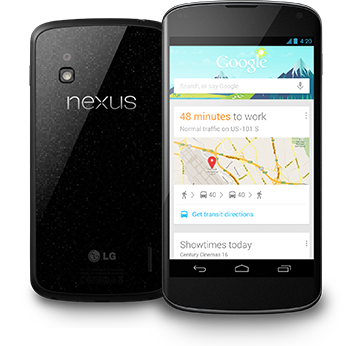
Nexus 4
Launched last November, this popular unlocked phone from Google and LG has a 4.7-inch display. How popular is it? It's often back-ordered 1 to 2 weeks!

https://lh6.ggpht.com/TWF21RygkFpkU-vKhdAxub1mF6L9xxoqc7aD1F6tD8ElCQFES4Ljn3yuUqcM1iZxC5A=w346
The wait is worth it, though.

The combination of quad-core processor and stock Android Jelly Bean — unencumbered with carrier "extras" — make the Nexus 4 a very snappy smartphone.

Although it's limited to HSPA+ "4G" connectivity, that's fast enough for an average user. Note that it will only work on GSM networks like AT&T and T-Mobile.

The previous version of the Nexus had a so-so 5MP camera. The 4's 8MP camera is a lot better and more fun, especially when taking panoramas. Both vertical and horizontal images can be stitched into stunning Photo Sphere pictures.

Cost, unlocked from Google: $299 (8GB); $349 (16GB). $50 down (16GB), plus $17 per month for 24 months at T-Mobile.

Samsung Galaxy Note II
There were a few jeers when Samsung unveiled the Galaxy Note II, a "phablet" (phone + tablet) with a gigantic 5.5-inch screen that includes an advanced S Pen stylus. Despite that, it has become a top choice of many mobile business users who need 4G connectivity and like to quickly jot down notes, make annotations and run two apps side by side.


The Galaxy Note II features a quad-core processor and runs on Android Jelly Bean. You can expand the 16GB or 32GB of internal storage up to an additional 64GB using a microSD card.

Cost: $300 (16GB) with 2-year contract from Sprint, Verizon and AT&T. $200 down, plus $20 per month for 24 months at T-Mobile.

Samsung Galaxy S4
The Samsung Galaxy is the phone line that grabbed attention away from the iPhone and shifted it toward Android.
samsung-galaxy-s4-story-album-02.jpg


The 4G LTE Galaxy S4 is the best version yet. With its polycarbonate shell available in white or gray, it looks a lot like the S III, but the S4 is lighter and thinner and features an expanded 5-inch HD screen, 13 MP rear camera and faster quad-core processor.

Samsung integrated a ton of useful, customized software features into the 4.2.2 Android Jelly Bean operating system. S Translator allows you to converse in 10 different languages while using email or the ChatOn instant messaging app. With S Health, fitness buffs can turn the phone into a pedometer and calorie-counter. In the car, control the phone hands-free with S Voice Drive.

Infrared technology allows users to tilt the phone up or down to scroll. You can also use your finger like an S Pen, but there's no need to actually touch the screen - just hover slightly above it. A video will pause if you look away from the screen and resume when you look back. The IR capability, by the way, also puts the S4 to work as TV remote.

Choose storage of 16, 32 or 64 GB, which can be expanded with up to a 64 GB microSD card.
Cost: Not known yet. Available in late April at AT&T, Verizon, Sprint and T-Mobile.

LG Optimus G
LG proved it can still make a splash in the smartphone world with the Optimus G, a close cousin of the Nexus 4.

http://forum.xda-developers.com/deviceForum/screenshots/1921/20121116T011729.jpg

Sprint's version features a powerful 13MP camera, although AT&T's model is no slouch at 8MP. Sprint's model has 32 GB of non-expandable storage, while AT&T's 16GB Optimus can be expanded via microSD card.

Either way, you'll get a blazing fast quad-core processor, 2GB of RAM and a nice 4.7-inch display.

Right now, the Optimus G is stuck on Android Ice Cream Sandwich, but it should get an update to the newer Jelly Bean soon.

Cost: $50 ($32GB) with a 2-year Sprint contract, new line only; $100 (16GB) with a 2-year AT&T contract.

Monday, March 18, 2013

Samsung Galaxy S4 vs iPhone 5 vs HTC One vs Blackberry Z10

So Samsung just unveiled its Samsung Galaxy S4, and you’re probably wondering how it stacks up to some of the latest and greatest from the Korean manufacturer’s biggest competitors. The Samsung Galaxy S4 stands tall up against heavy hitters like Apple’s iPhone 5, the HTC One, and the Blackberry Z10.

With its 5-inch 1080p HD Super AMOLED display, 1.6GHz Samsung Exynos 5 Octa chipset (or 1.9GHz quad-core chipset depending on which market you’re in), 2GB of RAM 13 megapixel camera with 2 megapixel front sensor, 4G LTE, Bluetooth 4.0, up to 64GB of internal storage with a microSD card slot for expansion, Android 4.2 with TouchWiz and more, this thing does not fail to impress.


Samsung’s biggest focus was on many of the new software and features added to TouchWiz, such as Air View, the new Smart Stay features with Pause and Resume, Samsung Smart Scroll, S Travel, S Health, S Translator, Group Play, S Voice Drive, and more. A Dual Camera feature will also allow you to take photos and videos with the front and rear cameras simultaneously. The stakes are high for 2013, so here are some of the biggest devices Samsung’s Galaxy S4 will be up against once the device launches in Q2:

iPhone 5

This is one of the biggest devices we’re comparing it to — after all, the legendary patent war between Samsung and Apple, as well as the big shots the former is taking at the latter in advertising, warrants a bigger spotlight. The iPhone 5 is still doing its own thing with a 4-inch Retina display, Apple’s 1.3GHz dual-core A6 processor, 1GB of RAM, 8 megapixel camera, iOS6 and more. This is Apple’s breadwinner so far, and although we’re expecting a refresh or sequel for 2013 this is still top dog in the Cupertino camp.

HTC One

HTC’s pride and joy for 2013 has set a pretty nice bar for others to match or exceed. The beautiful 1080p 4.7 inch display, the front-facing dual stereo speakers, the revolutionary UltraPixel camera and other unique features are to be reckoned with, and the latest facelift to HTC Sense with Blink Feed and a fresh user interface make the HTC One a sure winner. How it does numbers wise remains to be seen, but HTC is banking heavily on this one, and it’s telling that it borrowed the same “one device, all carriers” strategy Samsung successfully deployed for the Galaxy S3 and Galaxy Note 2.

Blackberry Z10

Blackberry, formerly RIM, probably won’t win any awards for its offering, but it being the company’s first device to help turn the ship around we felt it warranted inclusion here. It’s also something enterprise users will be watching closely as Samsung looks to challenge Blackberry, Apple and the rest with SAFE and Knox security features and initiatives. The Blackberry Z10 holds a special place in many hearts for those who are still holding on hope for the business king to survive.

Which one are you guys betting on for 2013? Are you going to be going with any of these new phones or are the options for 2013 enough to satiate your appetite for another year or so? Let us know how you’re feeling in the comments section below!

Friday, March 8, 2013

iPhone 4S Vs Galaxy Nexus Review

Are you trying to alter your previous smartphone? If you’ve got been reading lots of technical school blogs then your selections should have solely enclosed Samsung’ Galaxy Nexus and Apple’s iPhone 4S. every of those phones is special on their title. they need their own distinctive options that appear to high the one from the opposite. This makes it onerous to settle on between them.

But that’s if you’re not into jumping to bandwagons. most of the people would get the iPhone 4S as a result of it’s cool to possess one. you’ll say this for many of Apple’s gadgets. allow us to be from stereotyping and compare the 2 phones the method that they must be compared.
white-iphone-4
Performance


The iPhone 4S runs on Apple’s terribly own A5 processor, constant one that’s on the iPad two. it’s clocked at one Gc and is supported by 512 MB. On the other hand the Galaxy Nexus is power-driven by TX Instruments’ OMAP processor that is clocked at one.2 GHz. It additionally doubles the RAM of the iPhone 4S. Higher numbers ar higher though the distinction is refined throughout actual performance.

Apps
The number of apps on the Apple App Store is larger than those within the humanoid Market. a major range of these apps are literally well worth the purchase that are some things you cannot say for Androids. this can be the largest advantage of the iPhone 4S over the Galaxy Nexus.

Operating System
The Galaxy Nexus is that the 1st phone to possess humanoid frozen dessert Sandwich as its OS. This latest version of humanoid offers lots of enhancements each in performance and aesthetics. The iPhone 4S has the iOS five for its OS. it’s less complicated to use than ICS however you cannot create the selection between the phones supported OS. each OS ar that smart.

Camera
The iPhone 4S comes with a 8MP camera whereas the Nexus contains a 5MPix camera. Taking pictures on the iPhone are of higher grade photos with a 1080p HD camera.

Connectivity
Connectivity choices have become a giant consider selecting a phone. With the iPhone 4S, you’ll connect with the net through 3G and Wi-Fi. it’s additionally the primary phone to come back out with Bluetooth four, the most recent version of the popular wireless technology. With Bluetooth four, you’ll transfer files quicker ANd in an extended vary.

Meanwhile, the Galaxy Nexus will connect with the net victimisation 3G, Wi-Fi and 4G LTE. Through 4G LTE, you’ll expertise net speeds of up to twenty one Mbs. In distinction, the iPhone 4S will solely reach fourteen.4 Mbs. you will not have Bluetooth four with Galaxy Nexus however you’ve got close to Field Communication (NFC). often a replacement wireless technology wherever file transfers can be done simply by sound 2 NFC phones.

Conclusion
Have you determined that one is for you? The iPhone 4S has higher apps, camera and an easier interface. With the Nexus, you’ve got quicker net speeds, NFC, and frozen dessert Sandwich. verify our Galaxy Nexus vs. iPhone 4s review for a a lot of comprehensive comparison.

Wednesday, March 6, 2013

Best quad core phone: HTC One X vs ZTE Era vs LG Optimus 4X HD vs Huawei Ascend D Quad


We've seen a raft of quad-core phones launch during MWC 2012 and so it's time to pitch them against one another in a titanic QUAD BATTLE.

Don't think you'll be able to get these handsets on lower tariffs though - they are all high-end phones that will be available for a real premium when they launch. Which has the best specs? Read on to find out.

HTC One X vs LG Optimus 4X HD vs Huawei Ascend D Quad vs ZTE Era: Processor

Naturally, all the phones are quad-core; that's what this is all about, right? The HTC One X, ZTE Era and LG Optimus 4X HD have Nvidia Tegra 3 processors (featuring that secret fifth core). The One X and 4X HD have Tegras clocked at 1.5GHz but the ZTE Era is clocked at a barely-noticeable 0.2GHz slower. The Huawei Ascend D Quad is the handset that sticks out on a limb, with its own Huawei K3V2 chipset featuring a 1.5GHz quad-core processor. 


HTC One X vs LG Optimus 4X HD vs Huawei Ascend D Quad vs ZTE Era: Design

All these phones are rather fine-looking - the One X features a Unibody design formed from rather cool polycarbonate (super-lightweight with the ruggedness of metal, according to HTC). In our hands on we also approved of the LG's design. "Approach the LG Optimus 4X HD and you do feel that you are looking at a premium phone with the dual metal rims running around the circumference, sandwiching prism detailing which is part of LG's new signature design." The Ascend D and ZTE Era are also no slouches in the area of design, although we weren't too impressed by the plasticky sections on the back of the ZTE.
Here are the four handsets in pictures:
HTC One X


HTC one x

LG Optimus 4XHD


Huawei Ascend D Quad


ZTE Era


HTC One X vs LG Optimus 4X HD vs Huawei Ascend D Quad vs ZTE Era: Screen

The One X and Optimus 4X are strikingly similar – both have a 4.7-inch, IPS (no OLED) 720p HD screen (720 x 1,280 resolution) boasting a pixel density around the 312ppi mark. This compared to the iPhone 4S which clocks in around 329ppi. The Huawei Ascend D Quad offers a near-4S density of 236ppi because of its smaller 4.5-inch screen; it's still 720p HD. The ZTE Era is the poor relation here, with a 4.3-inch, 540 x 960 pixel display.

HTC One X vs LG Optimus 4X HD vs Huawei Ascend D Quad vs ZTE Era: OS

All the handsets feature Android 4.0 Ice Cream Sandwich. The HTC features the new Sense 4 overlay including HTC ImageSense, a new suite of camera features including improvements in shutter speed. LG has also added its own skin.

HTC One X vs LG Optimus 4X HD vs Huawei Ascend D Quad vs ZTE Era: Dimensions and weight

The One X is 9.3mm thick, considerably more than the 8.9mm LG Optimus 4X HD and Ascend D Quad and 7.8mm thick ZTE Era. In terms of footprint, the One X is larger (as you'd expect) at 134 x 70mm compared to the Ascend D Quad at 129 x 64mm. The Ascend D Quad weighs 130g, as does the One X. We're awaiting confirmation of the remainder of the measurement stats.

HTC One X vs LG Optimus 4X HD vs Huawei Ascend D Quad vs ZTE Era: Connectivity

All these handsets have 802.11n Wi-Fi, HSDPA, HSUPA and Bluetooth 3.0 aside from the LG Optimus 4X HD which includes Bluetooth 4.0. All have accelerometers, proximity sensors, gyros and a compass plus A-GPS. The One X features Beats audio and an NFC chip. The ZTE Era even features an FM radio.

HTC One X vs LG Optimus 4X HD vs Huawei Ascend D Quad vs ZTE Era: Camera

All the cameras are 8MP with full 1080p video recording and LED flashes – the Ascend D Quad is the only one to stray with a dual-LED flash. The secondary cameras in the One X, LG Optimus 4X HD and Ascend D Quad are 1.3MP, capable of 720p video. The secondary camera in the ZTE is VGA.


HTC One X vs LG Optimus 4X HD vs Huawei Ascend D Quad vs ZTE Era: Memory and storage

The LG and HTC have 16GB and 32GB of internal storage respectively, while the ZTE Era and Ascend D Quad both feature microSD storage as well as 8GB of internal storage. All the handsets have 1GB of RAM.

HTC One X vs LG Optimus 4X HD vs Huawei Ascend D Quad vs ZTE Era: Release date

The LG Optimus 4X HD release date, HTC One X release date and Huawei Ascend D Quad release date are all set for Q2 2012, so expect them in the late Spring or very early summer. The ZTE Era release date in Europe and China is in the second half of 2012.

Quad core battle: Karbonn Smart Titanium 1 vs Micromax Canvas HD

Desi brands are getting into Quad Core arena, lets see how the first two match each other.


Micromax jolted the market some days back when it announced its high definition display bearing Canvas HD smartphone which too became the first quad core processor bearing smartphone to be announced for around $273.00. But to Micromax's amazement, its arch rival Karbonn announced even a cheaper quad core processor based smartphone Smart Smart Titanium 1.

Karbonn gave another jolt to Micromax by making the Smart Titanium 1 available for Rs 10,990. It is now a even trickier position for many who are waiting to get their hands on Micromax Canvas HD as they now have an even cheaper quad core Android smartphone's option.

Notably, both have Android Jelly Bean operating system.

So let's look at the two smartphones head on to judge which is a better one.

Display:
Micromax Canvas HD comes with a high definition 5 inch display with 1280 x 720 pixel resolution. The Karbonn smartphone on the other hand has a 4.5 inch display, which is not that small compared to the Canvas HD. However, the Karbonn Smart Titanium 1's display has only 960 x 540 resolution.

Processor:
Of course, in this segment both the handsets look equal. However, a closer look will tell you that the Karbonn smartphone has an upper edge. The The Karbonn Smart S1 Titanium is powered by the Qualcomm Snapdragon quad-core processor clocked at 1.2 GHz. On the other hand, the Micromax Canvas HD has a MediaTek quad core processor with 1.2 GHz clockspeed. The MediaTek processor is not as coveted a brand as Qualcomm and has traditionally provided less polished CPUs compared to Qualcomm's well established Snapdragon chipsets.

RAM:
Both the handsets come with 1 GB RAM.

Battery:
The Micromax Canvas HD also scores over the Karbonn Smart Titanium 1 with its 2100 mAh battery against the 1600 mAh battery of the former.

Camera:
Both the smartphones have dual cameras but Micromax Canvas HD emerges out as the winner as it has an 8 megapixel rear camera along with a 0.3 megapixel front camera. The Karbonn Smart Titanium 1 has a 5 megapixel rear camera and a VGA camera in the front.

Conclusion:
Without a real life test, it is not possible to pass a final verdict. As the above comparison shows, both the handsets have their own high grounds. While Karboon Smart Titanium 1 has a better processor, the Micromax Canvas HD turns the table with its powerful battery, better camera and high definition display.

But all is well that is priced well, and thus Karbonn Smart Titanium 1 evens out all other odds as it costs almost $91.24 less than the Micromax Canvas HD. But as compared to Micromax Canvas II, which is priced at around $182.55, the Karbonn Smart Titanium 1 definitely seems a better choice.

Tuesday, March 5, 2013

Apple New iPhone 5S vs Huawei Ascend P2 – Specs, Features, Release Date, Prices

Apple iPhone 5s vs Huawei Ascend P2 – Huawei has recently unveiled the Ascent P2 and that has let loose a flurry of rumors and excitement throughout the cell phone world about what will be the nemesis for this technologically advanced device. People have high expectations from the iPhone 5S and are anticipating a lot of things from the device.

According to some trusted sources, the Apple iPhone 5S will retain the previous phone’s design, and this means that the form factor and the look and feel of the device will remain intact. The phone is supposed to measure 7.6mm thin design that weighs 112 grams with a display screen of 4 inch.

The features on the iPhone 5S are not to be taken lightly either. There is this retina display which promises to put in more vibrance on the phone and there are even reports that Sharp’s patented IGZO technology might see the face in the new phone. Of course, the OS is supposedly not being left out either, and an iOS 7 is supposedly on the cards.

iPhone 5S Leaked Photos by etradesupply.com

On the other end of the stick, the measurements of the Huawei Ascend P2 are 8.4 mm with a 4.7-inch 300 nits multi-touch screen display with pixel density of 315 ppi, which when compared to the iPhone 5S’ 326 ppi, is low. The Huawei has claimed that users will be able to access the Ascend P2 touchscreen even with using hand gloves, thanks to its Magic touch technology.
Huawei Ascend P2 Photo
The real battle unfolds when both the giants announce the release dates for their flagship models. For Apple, the Release Date has to be somewhere between March & October 2013. Huawei however, has not been clear with the launch dates and the best guess is the latter half of the year 2013.

source: ibtimes.com

Monday, March 4, 2013

Samsung Galaxy Xcover 2 vs Samsung Galaxy Young – Specs and Feature Comparison

We compare the specs and features of the Samsung Galaxy Xcover 2 and the Samsung Galaxy Young in a one on one battle. The Samsung Galaxy Young was announced earlier than the Galaxy Xcover 2. Both these smartphones seem to be budget smartphones and are targeted towards the mid-segment customer base.

The Samsung Galaxy Xcover 2 is a waterproof, dustproof and shockproof smartphone that can do almost everything that your standard smartphone can. So will the Galaxy Young be able to put up a fight against this new smartphone.

 Samsung Galaxy Xcover 2
 Galaxy Young
DISPLAY
The Samsung Galaxy Xcover 2 has a 4-inch capacitive touchscreen display. The display has a resolution of 800 x 400 pixels and a pixel density of 233 ppi. This smartphone dustproof and water resistant, hence the display is protected by a scratch-resistant glass which makes the screen rough and tough as well. The Samsung Galaxy Young features a 3.27-inch HVGA TFT touchscreen display. It has a display resolution of  480 x 320 pixels with a pixel density of about 206 ppi.

HARDWARE
The Samsung Galaxy Xcover 2 is powered by a 1 GHz dual-core processor, a standard GPU and 1 GB of RAM. This smartphone has a very decent hardware configuration which makes this rough and tough device fast enough. The Samsung Galaxy Young will most probably have a Snapdragon chipset. It will be powered by a 1 GHz single core processor, standard GPU and 768MB of RAM.

OPERATING SYSTEM
The Samsung Galaxy Xcover 2 runs on the latest version of Android operating system, the Android 4.1 Jelly Bean. This smartphone also has the Samsung TouchWiz UI which adds the personal touch of Samsung. The Samsung Galaxy Young runs on the latest Android operating system. This smartphone runs on Android 4.1 Jelly Bean.

STORAGE
The Samsung Galaxy Xcover 2 provides an in-built storage space of 4 GB. The storage space can be expanded with the help of a micro SD card. This smartphone supports micro SD cards of up to 32 GB. The Samsung Galaxy Young has an in-built storage space of 4 GB. This smartphone provides a micro SD card support of up to 32 GB.

CAMERA
The Samsung Galaxy Xcover 2 has a decent 5 MP Primary Camera with autofocus and LED flash and a VGA Secondary Camera. The Samsung Galaxy Young will have a 3 MP Primary Camera and a VGA Secondary Camera.

BATTERY
The Samsung Galaxy Xcover 2 has a Li-Ion 1700 mAh battery. This 1700 mAh battery gives a stand by time of up to 570 hours. The Samsung Galaxy Young has a 1300 mAh rechargeable battery. This smartphone will give a talk time of about 5 to 6 hours and a stand by time of about 200 hours.

DIMENSIONS
The dimensions of the Samsung Galaxy Xcover 2 are 130.5 x 67.7 x 12 mm. The dimensions of the Samsung Galaxy Young are 58.6 x 109.4 x 12.5 mm. Both these smartphones almost have the same thickness.

WEIGHT
The Samsung Galaxy Xcover 2 weighs about 148 grams where as the Samsung Galaxy Young weighs about 112 grams. The Galaxy Xcover 2 is a bit heavy because of the protective casing and display present on the device.

CONCLUSION
 The Samsung Galaxy Xcover 2 is definitely a smartphone that can be used in offices, work places, underwater, in the dirt and almost anywhere you can think of. The decent hardware configuration actually makes it a ‘smartphone’ which can do all your complex tasks as well.

This smartphone is rough and tough, dustproof and waterproof which makes it stand out from the crowd. If you are an adventurer or a person who loves t spend a lot of time outdoors, then this smartphone is definitely a good option for you.

Here is a specifications chart of Samsung Galaxy Xcover 2 and Galaxy Young:
SC - Xcover 2 vs Young

LG Optimus G vs HTC Butterfly vs Sony Xperia Z


LG has launched the Optimus G in India for $630.00, which is the second smartphone available in India with Qualcomm’s Snapdragon Pro processor after the HTC Butterfly. Though LG has done well to price the product in a price range close to the Samsung Galaxy S III and the HTC One X, will it be able to survive in this tough high-end mobile market? We pit the Optimus G against the HTC Butterfly and the Sony Xperia Z in a spec comparison to find out.

The Optimus G has been positioned at an interesting price point, which is bang in between that of devices like the Galaxy S III and the One X on the lower end and the HTC Butterfly at the other end of the spectrum. This makes it an interesting device, considering it has the top-of-the-line performance of the Butterfly and the Xperia Z but the display of the Galaxy S III and the One X. And this lack of a 1080p display is what stands out immediately. At a time when companies are providing big screens crammed with as many pixels as possible, LG’s 4.7-inch 720p screen loses out to the 5-inch 1080p display on both the Butterfly and the Xperia Z.

Performance wise though there is no differentiating between them, as all the three are powered by a quad-core Qualcomm Snapdragon S4 Pro processor clocked at 1.5GHz and a 2GB RAM. This should be enough to play any and every game in the market and watch HD videos smoothly.

When their photography prowess is compared the Optimus G features a 13-megapixel rear camera and a 1.3-megapixel front camera, while the Butterfly lags behind with an 8-megapixel rear camera and a 2-megapixel front camera. But as a package, the Xpeira Z comes out on top with a 13-megapixel rear camera and a 1.9-megapixel front camera.

In the memory department, though the Optimus G provides more internal memory at 32GB, an absence of expandable memory sees it lose out to the other two, which provide 16GB of internal memory along with a microSD slot.

In the battery department there is very little that separates the three with the Xperia Z leading with a 2,330mAH battery followed by the Butterfly’s 2,020mAH battery and the Optimus G comes last with its 2,100mAH battery. That said, the other two need more battery to power the larger, higher resolution displays.
Software-wise the Optimus G leads from the front with Android 4.1.2 Jelly Bean out of the box while the other two come with Android 4.1 and will later be upgradable. However, the Optimus G does not provide any manner of water or dust resistance, which is an added bonus on the other two.

On paper then the LG Optimus G looks to lose out with the 720p screen, but what is important is the pricing of the device. At $630.00, it is over $182.00 cheaper than the Butterfly and with the Xperia also expected to be priced around that range, the Optimus G does look like a bargain. So for us price-conscious Indians who look at buying a phone from the perspective of value for money and don’t mind missing out on a full HD display, the Optimus G makes a strong case for itself. But if a 1080p display is what you desire, then there is hardly anything separating the Butterfly from the Xperia Z.

Features LG Optimus G HTC Butterfly Sony Xperia Z
Processor Qualcomm Snapdragon S4 Pro quad-core 1.5GHz Qualcomm Snapdragon S4 Pro quad-core 1.5GHz Qualcomm Snapdragon S4 Pro quad-core 1.5GHz
RAM 2GB 2GB 2GB
Display 4.7-inch 720p 5-inch 1080p 5-inch 1080p
Memory 32GB, no memory slot 16GB, microSD card slot 16GB, microSD card slot
Camera 13-MP rear, 1.3-MP front 8-MP rear, 2-MP front 13-MP rear, 1.9-MP front
Battery 2,100mAH 2,020mAh 2,330mAh
Operating System Android 4.1.2 Android 4.1 Android 4.1
Price $630.00 $820.00 -

Nokia Lumia 720 Vs HTC 8S


At MWC Nokia added the Lumia 720 to its portfolio of Windows Phone 8 devices. The company has launched this product as a mid-range player as it aims to provide feature-rich experiences to its customers without burning a hole in their pockets. Knowing that there is hardly any option at present that offers the Windows Phone 8 experience at a sub-$340.00 price, Nokia Lumia 720 will be a tough competitor to mainly the HTC Windows Phone 8S. Read on to find out which device stands out in this battle of the mid-range heavyweights.

HTC had introduced 8S soon after the launch of Windows Phone 8 with an array of interesting features packed in a uni-body design available in various bright colors and framed in a 120.5x63x10.28mm chassis, which weight 113g. On the other hand Lumia 720 also features a uni-body design and comes with some accessory lines as well, but it’s a bigger device as it weighs 128g and has dimensions measuring 27.9×67.5×9.0mm.

While HTC ensured to launch this device with a myriad of features, Nokia has followed to the trail and has packed the device by not only focusing on its look but has also powered it with impressive hardware and some software additions.

To begin with the hardware, while HTC 8S flaunts 4-inch super LCD Gorilla Glass display offering WVGA resolution, Lumia 720 boasts a bigger 4.3-inch IPS ClearBlack screen 4 that is backed up by Corning Gorilla Glass 2 and has a WVGA resolution. Both the device run on WP8 though with software additions like Nokia Music and Nokia Here amongst many more give Lumia 720 an edge over the HTC 8S.

Processor wise, as Windows Phone 8 at minimum requires dual-core chips to run it, both the phones are powered by Qualcomm Snapdragon S4 dual-core processors which are clocked at 1GHz. However both devices are using the Qualcomm Snapdragon S4 Play chip that’s based on the ARM Cortex A5 architecture hence its nearly not as capable as the Snapdragon Plus CPU seen in the Lumia 920. Another common feature is the need of a MicroSIM.

On storage front, HTC 8S has 512MB RAM and offers 4GB storage on-board which can further be expanded using a microSD card. Nokia Lumia 720 offers more space for you to store with 512MB RAM, 8GB internal storage, microSD card support for up to 64GB and additionally 7GB storage space on cloud.
As far as the camera goes, Lumia carries a 6.7-megapixel snapper at the back with 2848×2144 pixels resolution and features like auto focus, flashlight and wide-angle lens. Notably, Nokia uses Carl Zeiss optic and has a very wide f/1.9 aperture, even the Lumia 920 does not boast of such a wide aperture.  Apart from that there is a 1.3-megapixel HD camera at the front with 1280 x 960 pixels resolution.

HTC on the flip side features a 5-megapixel camera with auto focus, LED flash, and is capable of 720p video recording, however misses a secondary camera. Nokia Lumia 720 has surely played it impressive on camera front, scoring better than the HTC 8S.

Connectivity options on both the devices are almost the same with both devices supporting Bluetooth, Wi-Fi and more, but with Lumia users get the taste of NFC as well. Additionally, the users of the Lumia 720 can also invest in a wireless charging back plate, which will enable wireless charging. This back plate is sold separately and will add to the cost of the device.

With all these features, you need these devices to have large battery life. At least on paper, Lumia 720 overtakes the HTC 8S by offering a 2,000mAh battery as compared to 1,700mAh battery on the 8S.
All in all on the face of it both devices are pretty similar in terms of specs, but Nokia does have an advantage on paper in terms of photography and also pre-loaded software, something, which no other Windows Phone 8 OEM can match.

The HTC Windows Phone 8S is available for $327.00, while Nokia has announced that the Lumia 720 will launch at a price of $341 in Europe which converts to $340.00, but as it has not launched yet we still can’t be sure of the price.

Here is close look at the specs of the HTC 8S and Lumia 720

HTC 8S Lumia 720
Dimension, weight 120.5x63x10.28mm, 113g 127.9×67.5×9.0mm, 128g
Processor Qualcomm S4 1 GHz, Dual-core Qualcomm S4 1 GHz, Dual-core
OS WP 8 WP 8
Display 4-inch super LCD Gorilla Glass display, WVGA 4.3-inch IPS ClearBlack Corning Gorilla Glass 2 display, (800x480p)
Camera 5-megapixel (2592Ñ…1944p) rear camera, no front camera with f/2.8 6.7-megapixel (2848x2144p) rear camera with f/1.9, 1.3-megapixel (1280 x 960p) front camera with f/2.4
Connectivity Bluetooth 3.0, WI-Fi 802.11 b/g/n Bluetooth 3.0, WI-Fi 802.11 b/g/n, NFC
Memory 512MB RAM, 4GB storage, microSD 512MB RAM, 8GB storage, up to 64GB microSD
Battery 1,700mAh 2,000mAh
Sensor G-Sensor Proximity sensor
Ambient light sensor
G-Sensor Proximity sensor
Magnetometer
Ambient light sensor
Price $327.00 approx. $340.00

Spec comparison: BlackBerry Z10 vs others Smartphone

 
Last night BlackBerry CEO Thorstein Heins took the stage and announced the BlackBerry Z10, the company’s first smartphone running BlackBerry 10. Now from a user-interface perspective, the Z10 is very fascinating and unique when compared to its competitors but from a hardware standpoint it is just matching whatever is available in the market and in some cases it’s not even achieving that. That said, it certainly has solid hardware and can give a decent fight to its rivals on the basis of its unique software. Read on to find out more.

From a spec-sheet standpoint, it has a 1.5GHz dual-core processor, a 4.2-inch 1280×768 pixel display with 356 PPI, 2GB of RAM, 16GB of internal memory, a 8-megapixel rear camera, a 2-megapixel front-facing camera, 1,800 mAh battery, microSD card slot and even NFC connectivity.

These specs are more or less in line with a top of the line smartphone from last year. Even if one looks at the Samsung Galaxy S III or the Nokia Lumia 920, both have 720p displays and both have Qualcomm Snapdragon S4 plus dual-core CPUs (For the Galaxy S III only in the US and it has a quad-core processor in India). Even in terms of photography, the Galaxy S III has an 8-megapixel camera, but the Lumia 920 wins this round thanks to its 8.7-megapixel PureView camera that comes with Zeiss optics and optical image stabilization for incredible low-light performance.

Even the iPhone 5 toes a similar line. Its new 4-inch panel maintains a resolution of 1136x 640 with 326 PPI and it comes with Apple’s latest dual-core A6 chip. Additionally, it comes in multiple memory variants and has an 8-megapixel camera that is considered to be among the best.

If one adds the newly launched HTC Butterfly to the equation, then the BlackBerry Z10 starts looking dated. The Butterfly has a 5-inch 1080p display, a quad-core Qualcomm S4 Pro processor, 16GB of memory, microSD card support, an 8-megapixel camera with HTC’s image sense chip, Beats Audio, and is also water resistant.

But hardware specs are only half the story and BlackBerry is in a unique position as it would leverage the new BlackBerry platform to stop its current users from migrating to other platforms. But with the absence of Google services and no integrated real-time turn-by-turn navigation, it would be difficult for the company to make Android or iOS users shift to BlackBerry. But this is just the first step for the company and being able to convince its faithful subscribers to continue would be great.
 
BlackBerry Z10 Nokia Lumia 920 Apple iPhone 5 Samsung Galaxy S III HTC Butterfly
1.5GHz dual-core processor 1.5GHz dual-core processor 1GHz dual-core A6 CPU 1.4GHz quad-core processor 1.5GHz quad-core CPU
2GB of RAM 1GB of RAM 1GB of RAM 1GB of RAM 2GB of RAM
16GB internal memory, microSD card support 32GB of storage 16/32/64 GB of storage 16/32/64GB of storage, microSD card support 16GB of storage, microSD card support
8-megapixel rear camera, 2-megapixel front camera 8.7-megapixel Pureview camera, 1.3-megapixel front facing camera 8-megapixel rear camera, 1.2-megapixel front-facing camera 8-megapixel rear camera, 1.9-megapixel front facing camera 8-megapixel rear camera with image sense, 2-megapixel wide angle camera
4.2-inch display, 1280×768, 356 PPI 4.5-inch PureMotion HD+ display 1280×768, 332 PPI 4-Inch Retina Display, 1136×640, 326 PPI 4.8-inch Super AMOLED HD Display, 1280x 720, 308 PPI 5-inch S-LCD Display, 1920×1080, 441 PPI
1,800 mAh battery, removable 2,000 mAh battery, non-removable 1,440 mAh battery, non-removable 2,100 mAh battery, removable 2,020 mAh battery, non removable
NFC, Bluetooth, Wi-Fi, HSPA+ NFC, Bluetooth, Wi-Fi, HSPA+ Bluetooth, Wi-Fi, HSPA+ NFC, Bluetooth, Wi-Fi, HSPA+ NFC, Bluetooth, Wi-Fi, HSPA+
BlackBerry 10 Windows Phone 8 iOS 6.1 Android 4.1 Jelly Bean Android 4.1 Jelly Bean
BBM Nokia Maps, Nokia Drive, City Lens, Cinematograph Apple Maps, Passbook, Game Centre ChatOn Messenger, TouchWiz UX Beats Audio, HTC Sense 4, waterproof and dust resistant

Wednesday, February 27, 2013

HTC One vs. iPhone 5

We compare the specs - and other features - of the HTC One and iPhone 5

Three years ago, one of Apple’s prime competitors from the Android side of the pond was the HTC EVO 4G. How times have changed. While Apple and Samsung duke it out at the top of the smartphone heap, HTC’s profits have dropped off the face of the earth. But everyone loves a good comeback story, and HTC is pulling out all the stops with its new flagship, the One. Read on, as we compare it to Apple’s top-selling iPhone 5.

Size

The One is another bigger-is-better Android phone, while Apple has focused on comfort in t...
There are bigger phones than the HTC One, but it still follows the recent trend of super-sized Android phones. The iPhone 5, meanwhile, is larger than its predecessors but small compared to the One.

The iPhone may be more comfortable to hold and use with one hand, while the One gives you a larger window into your apps and media.

Weight

The iPhone 5 is significantly lighter
The iPhone 5 is about 22 percent lighter than the HTC One. Both devices live in tightly-constructed aluminum bodies.

Display

The One's display is larger and has much higher (1080p) resolution
The One's screen has an extra (diagonal) 0.7 inch of screen real estate, and many more pixels.
Many high-end Android phones in 2013 are going to have 1080p displays, and the One is a card-carrying member of that club. It might be overkill, and – with some handsets – it might lead to crappy battery life. But your eyeballs may ultimately decide that it’s all worthwhile.

Processor

At least on paper, the One's Snapdragon is a beast
On paper, the One’s Snapdragon 600 chip wins hands-down. Its benchmarks will likely agree. Apple, though, prioritizes experience over specs, and it’s hard to argue that the iPhone 5 doesn’t blaze through iOS and most apps.

RAM

The One doubles the iPhone's 1 GB of RAM
The HTC One also comes out looking good here, with double the iPhone’s 1 GB of RAM.

Storage

The only difference here is the iPhone's 16 GB model
HTC skipped a 16 GB option, but otherwise flash memory is even. Neither device supports microSD cards for expandable storage.

Wireless

Where it's available, both phones support speedy LTE
In regions where it’s available, both phones support LTE networks. This is practically a given with modern high-end handsets (the Nexus 4 is a rare exception).

Battery

The One's battery holds more juice (it may need it to power that 1080p display)
The HTC One’s battery holds a lot more juice than the iPhone’s. Take this with grains of salt, though. Many other factors determine uptime, and the One’s battery has to power a display with over a million extra pixels.
Neither phone's battery is removable.

Cameras

HTC's 4MP ('ultrapixel') camera could potentially be better than some 13MP smartphone came...
Four megapixels doesn’t sound like a lot for the One’s shooter, but they’re what HTC calls “ultrapixels.” There are less of them, but they’re bigger. Combined with its f2.0 aperture and 1/3-inch backlit-CMOS sensor, HTC says the One’s camera will perform better in low light than competing smartphones.

On the software side, HTC’s handset introduces Zoe: a feature that simultaneously takes still-shots and records 1080p video. This gives you a plethora of options – including an animated “Living” image gallery, and the ability to choose the best from several shots.

Software

The One runs Android 4.1.2 (with Sense overlaid), while the iPhone runs iOS 6.1.2
HTC is emphasizing its custom software skin – Sense – and its intriguing new features. The most memorable part is BlinkFeed, a Flipboard-esque feed reader that sits front and center as a sort of home screen. It’s a bold departure from the standard grid of icons.

Hidden as it may be, the One still runs Android: 4.1.2 Jellybean to be exact (one full version behind Google’s latest major release). Like most Android devices, you’ll get your apps from Google’s Play Store.
The iPhone 5 runs iOS 6 (6.1.2 at the moment), Apple’s newest version of its mobile OS. You get iCloud for (sometimes) easy syncing, the Siri virtual assistant, and – gasp – Apple Maps. Perhaps the biggest highlight, though, is the App Store – with over 750,000 apps and games.

Wrap-up

Here we have two high-end smartphones with premium aluminum builds. The One’s specs come out ahead in many categories, but – at least if you jive with Apple’s philosophy – specs are but means to the end of experience.
No matter how you look at it, these are probably two of the best phones around (or will be – the One launches in mid-March). If you want to hold the magnifying glass to another killer handset, you can check out our comparison of the One with Samsung’s Galaxy S III.

HTC One vs Sony Xperia Z smartphone comparison

Smartphone technology promises to take a giant leap in 2013, with flagship handsets sporting large 5in full-HD touchscreens, 13Mp cameras, quad-core processors, more efficient battery life, plus dust- and waterproof designs. Getting a head-start on this week's Mobile World Congress in Barcelona, two of the first examples we've seen are the HTC One, aka HTC M7, and the Sony Xperia Z. So, how do these two high-end Android smartphones compare?
HTC One vs Sony Xperia Z: spec comparison

HTC One vs Sony Xperia Z: Price

The Sony Xperia Z lauches this Thursday (28 February), while fans of the HTC One will need to wait another couple of weeks to get their hands on the handset, which launches on 15 March. Both smartphones are available for pre-order now. See Android Advisor and our latest Android phone group test.

Both HTC One and Sony Xperia Z will be available on plans starting at £34 per month from Three, with an upfront cost of £69. Vodafone, meanwhile, is offering the Sony Xperia Z free on plans starting at £42 per month.

If you prefer to buy your smartphone SIM-free, the HTC One has a £519 RRP, according to Amazon, while the Sony Xperia Z is currently available to pre-order through the sales giant for £499 (RRP £549).

HTC One vs Sony Xperia Z: Dimensions

The Sony's larger 5in screen demands a bigger chassis than its 4.7in HTC rival, at 71x139mm versus 68.2x137.4mm. However, thanks to a super-thin skeleton chassis and a few tweaks to the layering of its screen technology, the Xperia Z remains the slimmer of the two, measuring just 7.9mm thick. Not that the HTC One is chunky, at just 9.3mm - it is in fact the lighter of the two: 143g against Sony's 146g.

HTC One vs Sony Xperia Z: Build

Both smartphones are beautifully designed, and feel utterly solid. The HTC One features an all-metal (lightweight aluminium) chassis and is beautifully put together; our only complaint is that its glass screen doesn't stretch from edge to edge.

Meanwhile, the Sony's squareish design is typical for an Xperia handset, although it's far more stylish than 2012's top-end S and T. Its front and back are durable tempered glass, with an anti-shatter film, although we're not keen on the grime-attracting gap between the two.

Sony's Xperia Z is also water-resistant up to 1m (for up to 30 minutes), and dust-proof. Although this means you can use the phone in a variety of conditions, it also demands that ports are covered in flaps that lessen the phone's premium feel. The Xperia Z is available in black, white and purple.

With largely similar weights and dimensions, both smartphones feel good in the hand.

HTC One vs Sony Xperia Z: Screen

HTC's One has the highest pixel density we've ever seen on a smartphone, cramming in a spectacular 468 pixels per inch. This 4.7in panel shows off full-HD content in razor-sharp glory, perfectly rendering details in photo and video even under harsh strip lighting. But while the HTC has the edge on picture resolution, the Sony Xperia Z bests it on screen size and colour.

Also with a full-HD (1920x1080) screen, but here stretched over 5 inches, the Xperia Z boasts an impressive 443ppi pixel density. Sony's Mobile Bravia Engine 2 analyses content and optimises the image sharpness, colour, contrast and noise reduction to suit. Sony dubs its screen 'Reality Display', with quality to match its Bravia HDTVs. It's also made a few tweaks to the screen layering technology, removing a layer of air to reduce reflections and glare, and integrating sensor and lens to improve responsiveness.

HTC One vs Sony Xperia Z: Processor & performance

Both HTC One and Sony Xperia Z pair 2GB of RAM with quad-core Qualcomm chips and Adreno 320 graphics. Sony specifies a powerful Snapdragon S4 Pro chip, clocked at 1.5GHz, while HTC offers the more recent 1.7GHz Snapdragon 600, also seen in the MWC 2013-unveiled Asus Padfone Infinity and LG Optimus G Pro.

Both running on the same Android 4.1 Jelly Bean software, we expect the HTC One to take the lead in performance. However, while we were able to spend some hands-on time with the HTC One at a launch event last week, we haven't yet been able to get it into our lab for full benchmarking. We aim to update our review at the earliest opportunity.

To date, the fastest Android smartphone we've benchmarked is Google's Nexus 4, which runs the very latest version of Android, 4.2 Jelly Bean. It scored 2,009 points in Geekbench 2, recorded framerates of 39fps in GLBenchmark 2.5, and was clocked at 1,906ms in the SunSpider JavaScript test. Although there's very little in it, the Sony Xperia Z failed to take the Nexus 4's crown: we recorded scores of 1,986 in Geekbench 2, 30fps in GLBenchmark, and 1,791ms in SunSpider. That's still incredibly fast, and the HTC could be even faster still. We can't wait.

Sony Xperia Z: Video review


Sony Xperia Z video review

HTC One vs Sony Xperia Z: Storage

HTC's One is available with 32- or 64GB of storage, and you can take advantage of 25GB of Dropbox storage free for two years. While the Sony Xperia Z offers a paltry 16GB in comparison, its microSDXC slot means you can very easily add up to 32GB, for a total of 48GB.

HTC One vs Sony Xperia Z: Cameras

It's all but impossible to compare cameras on the specifications alone, and the megapixel count doesn't directly correlate with picture quality. This is something HTC hopes to address with its UltraPixel Camera, which has a 4Mp rear camera with a BSI sensor and f2.0 aperture.

That 4Mp isn't a typo: using ultra- rather than megapixels, this camera is said to let in 300 percent more light than comparable 13Mp cameras. It can shoot full-HD video at 30fps (720p at 60fps), and take 16:9 still images at 2688x1520 pixels. There's also a burst mode that can capture up to 20 stills and a three-second video, making sure you get exactly the shot you wanted. HTC calls this Zoe.

The HTC One also sports a 2.1Mp front-facing camera with HDR capability for full-HD video chat.

Sony's Xperia Z, meanwhile, is the first of many smartphones to enter the market in 2013 with a 13Mp sensor. This snapper uses Sony's Exmor RS BSI sensor to offer very good photos, and it's the first smartphone to support HDR for video as well as still images. There's a 16x digital zoom, the ability to take stills in video mode, and a burst mode that'll capture 9Mp snaps at 10fps until you run out of storage or battery power. Waterproof to 1m, you can capture snaps wherever you are.

Sony uses an Exmor R sensor for its 2Mp (full-HD) front camera for improved picture quality in low light.

HTC One vs Sony Xperia Z: Connectivity

In terms of connectivity, there's very little difference between these two smartphones. Both offer 4G LTE connectivity, Wi-Fi, Bluetooth 4.0, NFC, DLNA, GPS and Glonass, HDMI (via MHL), and Micro-USB. Combined with its Sense TV app, the HTC One can also function as a remote control for your TV.

HTC One vs Sony Xperia Z: Software

Both smartphones run Android 4.1 Jelly Bean, with Sony promising an upgrade to 4.2 shortly after launch (this may bring its performance closer to that of the Nexus 4). Sony's interface will be familiar to Xperia fans, and the company provides its own Music Unlimited and PlayStation Mobile apps as part of the Sony Entertainment Network. The interface is otherwise largely untouched.
HTC, on the other hand, runs a heavily customised version of Jelly Bean with its Sense 5.0 overlay. Sense includes features such as the aforementioned Zoe and Sense TV, as well as BlinkFeed, which streams all your favourite content to tiles on your home screen. There's also HTC BoomSound and Beats Audio which, combined with dual front speakers and powerful amplifiers, allow you and your mates to truly enjoy content without a pair of headphones. Sense Voice is also here, with dual mics detecting and compensating for loud background noise by tweaking the in-call volume for improved clarity.

HTC One vs Sony Xperia Z: Battery

The display is usually the chief culprit behind battery drain, and with large full-HD panels fitted to these smartphones you might expect runtime to be a problem. The Xperia Z has an ever-so-slightly larger-capacity battery than the HTC One, at 2,330mAh versus 2,300mAh, and both are non-removable. Sony claims its battery will stretch to 11 hours of talk time and 550 hours on standby, but we certainly wouldn't expect either to last much longer than a full day's use.
The Xperia Z has a very useful Battery Stamina mode, which turns off unnecessary functions such as Wi-Fi and data traffic when the screen is off (you still receive incoming calls and texts).

HTC One vs Sony Xperia Z: Verdict

Until we've had time to properly benchmark the HTC One it's difficult to give a definitive verdict. On paper it should beat the Xperia Z, but in reality HTC's heavy Sense overlay may slow performance. We suspect the difference between the two will not be enough to affect your purchasing decision.
We also want to get a better look at that camera. We all know megapixels aren't everything when it comes to image quality, but can the HTC One's 4Mp snapper really take on the Xperia Z's 13Mp Exmor RS sensor? It's a tough act to follow.
Performance and camera quality aside, both smartphones are premium devices with a desirable design and a similar weight and feel. They're evenly matched in connectivity terms, and each offers a stunning displays - the HTC's is sharper, while the Sony offers better colours and more screen estate. The Sony has less storage, but you can add a microSDXC card. The HTC One and Xperia Z even cost about the same amount.
Until we've had time to properly test the HTC One, we're swayed toward the Xperia Z's larger, more colourful screen. However, HTC Sense offers a number of benefits over plain Jelly Bean, and that camera and powerful processor may yet tip us in the other direction.
- See more at: http://www.pcadvisor.co.uk/reviews/mobile-phone/3428492/htc-one-vs-sony-xperia-z-smartphone-comparison-review/?pn=2#sthash.7HquwrRw.dpuf

HTC One vs Sony Xperia Z: Connectivity

In terms of connectivity, there's very little difference between these two smartphones. Both offer 4G LTE connectivity, Wi-Fi, Bluetooth 4.0, NFC, DLNA, GPS and Glonass, HDMI (via MHL), and Micro-USB. Combined with its Sense TV app, the HTC One can also function as a remote control for your TV.

HTC One vs Sony Xperia Z: Software

Both smartphones run Android 4.1 Jelly Bean, with Sony promising an upgrade to 4.2 shortly after launch (this may bring its performance closer to that of the Nexus 4). Sony's interface will be familiar to Xperia fans, and the company provides its own Music Unlimited and PlayStation Mobile apps as part of the Sony Entertainment Network. The interface is otherwise largely untouched.

HTC, on the other hand, runs a heavily customised version of Jelly Bean with its Sense 5.0 overlay. Sense includes features such as the aforementioned Zoe and Sense TV, as well as BlinkFeed, which streams all your favourite content to tiles on your home screen. There's also HTC BoomSound and Beats Audio which, combined with dual front speakers and powerful amplifiers, allow you and your mates to truly enjoy content without a pair of headphones. Sense Voice is also here, with dual mics detecting and compensating for loud background noise by tweaking the in-call volume for improved clarity.

HTC One vs Sony Xperia Z: Battery

The display is usually the chief culprit behind battery drain, and with large full-HD panels fitted to these smartphones you might expect runtime to be a problem. The Xperia Z has an ever-so-slightly larger-capacity battery than the HTC One, at 2,330mAh versus 2,300mAh, and both are non-removable. Sony claims its battery will stretch to 11 hours of talk time and 550 hours on standby, but we certainly wouldn't expect either to last much longer than a full day's use.

The Xperia Z has a very useful Battery Stamina mode, which turns off unnecessary functions such as Wi-Fi and data traffic when the screen is off (you still receive incoming calls and texts).

HTC One vs Sony Xperia Z: Verdict

Until we've had time to properly benchmark the HTC One it's difficult to give a definitive verdict. On paper it should beat the Xperia Z, but in reality HTC's heavy Sense overlay may slow performance. We suspect the difference between the two will not be enough to affect your purchasing decision.

We also want to get a better look at that camera. We all know megapixels aren't everything when it comes to image quality, but can the HTC One's 4Mp snapper really take on the Xperia Z's 13Mp Exmor RS sensor? It's a tough act to follow.

Performance and camera quality aside, both smartphones are premium devices with a desirable design and a similar weight and feel. They're evenly matched in connectivity terms, and each offers a stunning displays - the HTC's is sharper, while the Sony offers better colours and more screen estate. The Sony has less storage, but you can add a microSDXC card. The HTC One and Xperia Z even cost about the same amount.

Until we've had time to properly test the HTC One, we're swayed toward the Xperia Z's larger, more colourful screen. However, HTC Sense offers a number of benefits over plain Jelly Bean, and that camera and powerful processor may yet tip us in the other direction.

  HTC One
Sony Xperia Z
Display
   
Screen size
4.7in
5in
Resolution
1,920 x 1,080 pixels
Pixel density
469ppi
441ppi
Type
TFT LCD
TFT LCD
Processor and battery
   
Family
Snapdragon 600
Qualcomm Snapdragon S4
CPU
Krait 300
Krait
Cores
Quad-core
Quad-core
Clock speed
1.7GHz
1.5GHz
GPU
Adreno 320
Adreno 320
Battery
2,300mAh
2,330mAh
Claimed 3G talk time
TBC
Up to 11 hours
Storage and memory
   
RAM
2GB
2GB
Internal storage
32GB / 64GB
16GB
microSD
No
Yes
Camera
   
Rear
 4-megapixel
13.1-megapixel
Video
1080p @ 30fps
1080p @ 30fps
Front
2.1-megapixel
2.2-megapixel
Wireless
   
Standard
4G LTE
4G LTE
Wi-Fi
802.11 a / b / g / n
802.11 b/g/n
NFC
Yes
Yes
Bluetooth
v4.0
v4.0
Integrated wireless charging
No
No
Dimensions
   
Size
137.4 x 68.2 x 9.3mm
139 x 71 x 7.9mm
Weight
143g
146g
Operating System
Android 4.1 Jelly Bean w/Sense 5.0
Android 4.1 Jelly Bean
Price (SIM-free)
£510 via Clove
£500 via Amazon

You might also like:

Related Posts Plugin for WordPress, Blogger...

Infolinks In Text Ads