Chitika

Showing posts with label NEWS. Show all posts

Wednesday, April 3, 2013

Samsung Galaxy S4 price revealed to be 690 Euros in Portugal


samsung-galaxy-s4-story-album-02.jpg
 
Samsung Galaxy S4 is expected to start retailing in select markets from April 26. After the price in US and UK for the much-awaited smartphone were revealed, there's confirmation of the price elsewhere in Europe.According to PhoneArena, in Portugal the 16GB version of Samsung Galaxy S4 will cost 689.99 Euros, or roughly Rs. 48,100. This price has been indicated by Portuguese arm of smartphone retailer Expansys, which is taking pre-orders for both black and white variants of Samsung Galaxy S4.

As per earlier reports, AT&T will start taking pre-orders for the Samsung Galaxy S4 from April 16 for $250. The amount is $50 above the usual introductory price for high-end smartphones, including Apple's iPhone 5. There were unofficial reports that the unlocked Samsung Galaxy S4 will be available for approximately $579, but based on the US contract pricing and the unlocked pricing in other countries, the actual price should be much higher.

While in UK the customers will have to shell 41 Pounds a month to get their hands on the Samsung Galaxy S4 as per the listing by Phones4U. There are no upfront charges to be paid if a customer opts for this plan. It is expected that the 4G plans for Samsung Galaxy S4 are even more expensive as customers are required to pay a one time fee of 270 UK pounds in addition to the monthly fee of 31 Pounds.

As per the pre-order listing by Amazon the UK customers will have to shell out 699 Pounds for the 16GB version of the Samsung Galaxy S4.

There was another report on the European pricing for the Samsung Galaxy S4. Amazon DE has been taking pre-orders for the much awaited smartphone for 650 Euros.

So far, there is no word in regards to India availability or what could be the tentative price for this smartphone, but based on the pricing in other regions, customers should be prepared for pricing around the Rs. 50,000 mark.

Just to recap, Samsung Galaxy S4 sports a 5-inch full-HD screen with a resolution of 1080x1920 pixels, and pixel density of 441ppi. It is powered by 1.6GHz Exynos octa-core processor in some regions, and a 1.9GHz Qualcomm Snapdragon quad-core processor in others. It has 2GB of RAM and a PowerVR SGX544MP3 triple-core GPU.

The smartphone will come in 16GB, 32GB and 64GB variants but will also feature a microSD card slot for expanding the memory. The Galaxy S4 sports a 13-megapixels rear shooter and a 2-megapixel one on the front. The Galaxy S4 also offers more camera features including dual-shot, employing the use of both front and back camera, an eraser shot mode to remove people from photos, and a Cinemagram like feature called Cinema Photo, among several other tricks.

Samsung is also rumoured to be working on the Samsung Galaxy S4 mini, which is expected to be launched this week. As per leaks, Samsung Galaxy S4 mini will sport a 4.3-inch qHD Super AMOLED display with 256ppi. The smartphone will allegedly come with 1.6GHz dual-core processor. It is expected to run on Android 4.2.2 (Jelly Bean) along with TouchWiz Nature UX 2.0. News reports also suggest that Samsung will be launching Galaxy S4 mini in both single-SIM and dual-SIM variants.

7 best smartphones to consider now

If you're ready to drop some money on one of the latest and greatest smartphones, you have some great choices — too many, in fact.

Turbocharged quad-core processors and wireless charging have nearly become standard on top-of-the-line Android phones. As always, the latest iPhone and its gorgeous screen and vast ecosystem of content is worth your consideration. For those looking to break free of iOS or Android altogether, the underrated Windows Phone 8 awaits.

How can you possibly decide? I've rounded up the 7 best smartphones available and I'll tell you what makes them good.

HTC One
Honed from a slab of aluminum, this 4G LTE flagship from HTC wows on looks and specs. It features a high-resolution 4.7-inch screen, 32 or 64 GB of storage, and is powered by a quad-core processor.


htc-soft2

HTC also worked hard on customizing the latest version of the Android operating system, Jelly Bean. The BlinkFeed feature gives you a live-updated home screen similar to Windows Phone 8. You pick the social networks and news feeds you want to stay tuned into.

While other phone makers race to up camera megapixel counts, HTC went in the other direction with the One's UltraPixel Camera. It has fewer megapixels, but a bigger sensor than other smartphones. If you love to shoot in low light or at night, you should give the One a serious look.

Cost: Not known yet. Available in April at AT&T, T-Mobile and Sprint.

iPhone 5
Apple's flagship smartphone — introduced last September — has a 4-inch Retina screen and the ability to connect to 4G LTE networks from Verizon, AT&T and Sprint.
 
 
Because of the new Lightning dock connector and dual-core A6 processor, the iPhone 5 is notably slimmer than the 4S and twice as fast.

The rear camera's sensor matches the 4S in size, 8 megapixels, but captures much better pictures in low-light situations.

For many users, the iPhone 5's best feature will be access to the App Store, which is rapidly approaching the milestone of 1 million apps. 

Cost: $199 (16GB); $299 (32GB); $399 (64GB) with 2-year contract at AT&T, Sprint and Verizon. $100 down (16GB), plus $20 per month for 24 months at T-Mobile.

Apple also sells an unlocked, contract-free iPhone 5 starting at $649. It only works on GSM networks, such as AT&T and T-Mobile in the U.S.

HTC 8X
Want something different than iOS or Android? The Windows Phone 8 operating system is a good place to look. Its unique "live tile" home screen is a definite winner.


If you want to try it out, the HTC 8X with 4.3-inch display is an excellent choice.

This sleek and compact phone boasts a speedy dual-core processor and 1GB RAM on the inside, which is a big improvement over past Windows Phone units. Plus, it's 4G LTE-capable.

The Windows Phone 8 operating system has far fewer apps available for it, compared to iOS and Android, but you'll stay productive with mobile versions of Excel, Word, OneNote and PowerPoint. The built-in People Hub keeps all your social media feeds organized in handy place.

Non-expandable storage maxes out at 16GB, but that can be extended with Microsoft's SkyDrive cloud storage service.

Cost: $100 (16GB), with a 2-year Verizon or AT&T contract. $0 down, plus $18 per month for 24 months at T-Mobile.

Although thicker and heavier, the Nokia Lumia 920 ($100, AT&T) is another great option for Windows Phone fans.

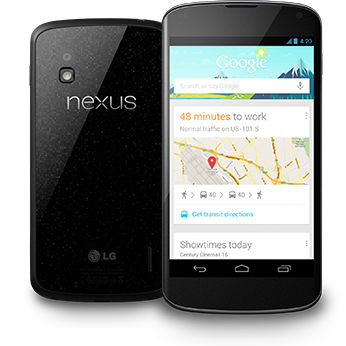
Nexus 4
Launched last November, this popular unlocked phone from Google and LG has a 4.7-inch display. How popular is it? It's often back-ordered 1 to 2 weeks!

https://lh6.ggpht.com/TWF21RygkFpkU-vKhdAxub1mF6L9xxoqc7aD1F6tD8ElCQFES4Ljn3yuUqcM1iZxC5A=w346
The wait is worth it, though.

The combination of quad-core processor and stock Android Jelly Bean — unencumbered with carrier "extras" — make the Nexus 4 a very snappy smartphone.

Although it's limited to HSPA+ "4G" connectivity, that's fast enough for an average user. Note that it will only work on GSM networks like AT&T and T-Mobile.

The previous version of the Nexus had a so-so 5MP camera. The 4's 8MP camera is a lot better and more fun, especially when taking panoramas. Both vertical and horizontal images can be stitched into stunning Photo Sphere pictures.

Cost, unlocked from Google: $299 (8GB); $349 (16GB). $50 down (16GB), plus $17 per month for 24 months at T-Mobile.

Samsung Galaxy Note II
There were a few jeers when Samsung unveiled the Galaxy Note II, a "phablet" (phone + tablet) with a gigantic 5.5-inch screen that includes an advanced S Pen stylus. Despite that, it has become a top choice of many mobile business users who need 4G connectivity and like to quickly jot down notes, make annotations and run two apps side by side.


The Galaxy Note II features a quad-core processor and runs on Android Jelly Bean. You can expand the 16GB or 32GB of internal storage up to an additional 64GB using a microSD card.

Cost: $300 (16GB) with 2-year contract from Sprint, Verizon and AT&T. $200 down, plus $20 per month for 24 months at T-Mobile.

Samsung Galaxy S4
The Samsung Galaxy is the phone line that grabbed attention away from the iPhone and shifted it toward Android.
samsung-galaxy-s4-story-album-02.jpg


The 4G LTE Galaxy S4 is the best version yet. With its polycarbonate shell available in white or gray, it looks a lot like the S III, but the S4 is lighter and thinner and features an expanded 5-inch HD screen, 13 MP rear camera and faster quad-core processor.

Samsung integrated a ton of useful, customized software features into the 4.2.2 Android Jelly Bean operating system. S Translator allows you to converse in 10 different languages while using email or the ChatOn instant messaging app. With S Health, fitness buffs can turn the phone into a pedometer and calorie-counter. In the car, control the phone hands-free with S Voice Drive.

Infrared technology allows users to tilt the phone up or down to scroll. You can also use your finger like an S Pen, but there's no need to actually touch the screen - just hover slightly above it. A video will pause if you look away from the screen and resume when you look back. The IR capability, by the way, also puts the S4 to work as TV remote.

Choose storage of 16, 32 or 64 GB, which can be expanded with up to a 64 GB microSD card.
Cost: Not known yet. Available in late April at AT&T, Verizon, Sprint and T-Mobile.

LG Optimus G
LG proved it can still make a splash in the smartphone world with the Optimus G, a close cousin of the Nexus 4.

http://forum.xda-developers.com/deviceForum/screenshots/1921/20121116T011729.jpg

Sprint's version features a powerful 13MP camera, although AT&T's model is no slouch at 8MP. Sprint's model has 32 GB of non-expandable storage, while AT&T's 16GB Optimus can be expanded via microSD card.

Either way, you'll get a blazing fast quad-core processor, 2GB of RAM and a nice 4.7-inch display.

Right now, the Optimus G is stuck on Android Ice Cream Sandwich, but it should get an update to the newer Jelly Bean soon.

Cost: $50 ($32GB) with a 2-year Sprint contract, new line only; $100 (16GB) with a 2-year AT&T contract.

Friday, March 15, 2013

Samsung's gaming controller shows a heavy Xbox influence

samsung galaxy s4 gaming controller (engadget)

While there weren’t a lot of surprises at Samsung’s big Galaxy S4 unveiling today, one place the company never isappoints is in kooky accessories, and today was no exception. Engadget reports that the company was showing off its own Bluetooth gaming controller, complete with dual analog sticks, four face buttons, shoulder buttons, and a D-Pad. It looks pretty much exactly like an Xbox 360 controller, down to the colors of the face buttons, the positioning of the sticks, and the D-Pad design.

Maybe Samsung will have some better luck


The smartphone gaming controller space has filled out over the past year as more companies try to provide a console-like gaming experience on the go, but there still hasn’t been a breakout success story. Since this would be a first-party accessory, maybe Samsung will have some better luck — that is, if it can stave off those pesky design patent lawsuits. No word on pricing, but the controller should be headed to stores sometime this summer.

The Fujitsu Stylistic S01 is an Android smartphone simplified for seniors, but packed with features

BARCELONA, Spain--It's important to respect your elders. And the Fujitsu Stylistic S01 for seniors manages to be simple enough for those who aren't used to smartphones without being patronizing, by offering features that pretty much anyone would find useful.
Many phones aimed at older users, or those who might struggle with fiddly touchscreens, go for big chunky plastic buttons. But the S01 takes a less patronizing approach, aiming for a simplified smartphone experience that can be enhanced as the user gets to grips with what's on offer.
The first thing you notice when using it is that the touchscreen doesn't work by simply tapping on the screen, like a regular phone. Instead, the screen is pressure-sensitive, so you press a bit harder to activate the feature you want, avoiding accidental button pushes. Each tap gives you a small buzz of haptic feedback.
The S01 is an Android phone running Android 4.0.4 Ice Cream Sandwich, but there's a whole new interface placed on the top. Everything is arranged on one screen, so there's no swiping left or right to multiple home screens. Instead, apps are placed on the screen in order of importance. The most commonly used apps are at the top, with larger icons so they're easier to press.
So the phone dialer, text messages, email and Facebook are arranged at the top, along with three speed-dial buttons. They're color-coded to match the sections of the manual so you can quickly find help to use them. Each of the basic apps has a question mark in the top right that explains how to use it.
Beneath the basic functions is an icon marked My Number, handy if you have trouble remembering your number (and who doesn't?).

Scroll down and you start to get more smartphone-like functions, like a widget displaying the latest headlines, and a simple Google search box. Then there's the camera, maps, access to the Google Play online app store, and more.
Keep scrolling down and you reach the rest of your apps, including things like Amazon, TripAdvisor and more. You can add to the list by downloading more apps and games from Google Play.
On the hardware side, the S01 is waterproof so will survive a dunk in the toilet or sink. If you have a spill of a more worrying kind, you can activate an alarm by pulling out a button on the back should you fall or have an accident. The alarm alerts people nearby, while the phone automatically dials out to specified emergency contacts. If it detects that your emergency contact has gone to voice mail, it dials the next person on the list, and so on.
It has a dedicated camera button to make it easy to capture a snap without messing about with the touchscreen, and selected friends and family can send photos that automatically appear on the phone without you having to do anything.
Handily, you don't need a cable to charge the S01: just drop it in a dock like a cordless phone, making it easier to answer without being tangled up in a cord.
Wireless charging, a simplified interface, waterproof exterior...come to think of it, forget about seniors: I want these features on every phone.
The Fujitsu Stylistic S01 is coming to Orange in June. For more on the latest phones, tablets and mobile devices -- including a prototype GPS walking cane that guides seniors to their destination 

Firefox OS coming within weeks on sub-$150 Geeksphone Keon

BARCELONA, Spain--Mozilla's new mobile operating system, Firefox OS, has already shown its face on a handful of upcoming devices from Alcatel and Huawei. This time it's the turn of the imaginatively titled company Geeksphone with the 3.5-inch Keon smartphone. Aimed more toward developers wanting a cheap phone to test apps on, the Keon will be priced between $100 and $150 when it goes on sale in the next few weeks worldwide, making it the first Firefox OS phone available to buy.
If you've already seen our hands-on with Alcatel's One Touch Fire smartphone then you'll be instantly familiar with the Keon. They're almost identical, so much so that I struggled to tell them apart in our photos. Like the Fire, the Keon is a 3.5-inch device, wrapped in a bright "Firefox orange" casing.
The opening screen of Firefox OS running on a Geeksphone Keon.
(Credit: Stephen Shankland/CNET)
The Keon sits very easily in your palm and its chunky, rounded back makes it quite comfortable to hold. It doesn't ooze the style and sophistication of Sony's Xperia Z smartphone, but it's arguably a lot more fun. It more closely resembles the colourful, curvy Nokia Lumia 620. Tucked into that orange back is a 3-megapixel camera and you'll find a microSD card slot on the device as well.
The 3.5-inch display has a 480x320-pixel resolution. That's far from the Full HD screens we're seeing on many new phones, but for the price, you really can't ask for much more than that. It seemed fairly bright, although colors didn't exactly seem to pop. I was only able to view it under the searing lights of the conference center so I'll reserve my judgement for the full review.
The Keon is running Mozilla's brand-spanking-new Firefox OS. It's open-source software, based heavily on HTML5, which Geeksphone CEO Javier Aguera Reneses explained to me is less demanding of hardware. I sincerely hope that's true, as the Keon is only powered by a very weedy 1GHz processor.
Visually, Firefox OS looks a little like a cross between Android, with the multiple home screens, and iOS, with the large grid of app icons. It looks quite neat and fairly attractive, but without being able to spend a longer time with the phone, I'll have to again leave my final verdict for later. One of the problems it will face however is apps.
With developers already showing little enthusiasm for bringing their apps to a third platform after iOS and Android, it's unlikely they'll want to do it for Firefox OS. However, Mozilla reckons that the open nature of HTML5 on Firefox OS should mean that existing HTML5 Web apps can be easily tuned for phones. Whether that really is the case remains to be seen.
Again, the Keon is aimed mostly at developers, wanting a cheap and cheerful phone to build apps on. The benefit -- according to Reneses -- is that developers will receive updates to the OS within a day or so of them becoming available, rather than in weeks or months as is the case with Android. The Keon will be available for anyone to buy, though, developer or not.


Samsung Galaxy S4 launches in New York

Samsung has unveiled its latest flagship smartphone, with a host of gesture based features


After months of speculation Samsung has launched the Galaxy S4 at an event in New York.

The flagship handset will be available on April 25th in the UK.

As expected it’s a big screened, tooled up, flagship device – and Samsung will be looking to replicate the success it had with the preceding Galaxy S3. 327 mobile operators world wide will carry the phone.

This isn’t just about a specs upgrade - a lot of the emphasis is on new ways of interacting with a phone, such as gesture control, eye tracking and a number of other smart features.

Check out our Samsung Galaxy S4 hands on.


Samsung Galaxy S4 Camera

The S4 has a number of new camera features, some of which are based on using the front and back camera simultaneously.

Dual Shot lets you take two pictures simultaneously (with the front and back cameras) and merge them together – having the rear shot as an insert in the main image, for example.

Dual Recording does the same thing, but for video.

If your photo has been spoiled by a blurred image of a person moving quickly in the background, Racer Shot will remove it.

Sound Shot will record nine seconds of sound at the point of capture, which can be tagged to the photo.

Drama Shot takes a burst series of snaps and combines them to create one photo – this is pitched as ideal for action shots. So if used to capture a diver leaping off a cliff, there would appear to be eight bodies arcing through the air.

Meanwhile, Cinema Photo lets you select still shots from video and create gifs. The Galaxy S4 also comes with Story Album, a feature which helps you group photos by analysing the location, surroundings and recognising the people in the images.

Samsung Galaxy S4 Specs

As you’d expect, the superphone is tooled up with the latest components.

Processor: Exynos 5 Octo 1.6MHz

RAM: 2GB

Storage: 16GB, 32GB, 64GB. Up to 64GB with Micro SD

Screen: 5-inch Full HD super Amoled 441PPI

Camera: 13 MP front camera, 2MP rear camera

Video: 1080p recording

Operating system: Android Jelly Bean 4.2.2

Dimensions: 69.8mm 136.6mm, 7.9mm thin

Weight: 130g

Battery:  2,600mAH

Samsung Galaxy S4 features

The phone has a number of gesture and ‘eye reading’ features, some of which can be found in its Note series, but most of which are brand new.

Having registered the fact you’re looking at it, Smart Pause will pause the video you’re watching if you look away from the screen, and then resume when you look back.

Wave your hand in front of the screen without touching it and Smart Gesture will pick the movement up, allowing you to scroll across or down. So you can browse pages or navigate the phone without actually touching the screen. A waving gesture can also answer a call.

With Air View you can  hover your finger over message to preview it – a function seen on the Galaxy Note series.  This is pitched for use taking a peek at emails, calendar items and Flipboard Videos instead of having to fully open them. You can also scroll through screens by tilting the device, thanks to something called Smart Scroll.

S Health is a series of - you guessed it - fitness features – including a pedometer, calorie counter, and humidity sensor. It will track your exercise and keep you updated on progress.

If your TV has an IR receiver, Watch ON allows you to pair it to the S4, change channel, select a video on demand, or pull down information.

Group Play lets up to eight S4s link up via NFC or manually to play games or listen to the same songs.

S Translator recognises nine different languages and works both ways, translating your text and then listening to the person's response it shows you the reply in your own native language. It can also be embedded into email, chat or messaging.

Samsung Optical Reader picks up QR codes, and can read things like business cards and know what information it needs to pick out for your records, apparently.

You can also share the screen with another S4, and share annotations, make three-way video calls and duel camera video calls.

Adapt Display is a new tech that comes with the Galaxy S4's large 5-inch Full-HD display, by analysing the surroundings and the type of content you're viewing the screen is optimised.
One of the major updates to the screen is the fact that you can use the Galaxy S4 whilst wearing gloves, placing it alongside a limited number of other hansets including the Lumia 920.

There’s no word on price yet, but the S4 will be available from all the major networks in the UK at the end of April 2013.

Will the Samsung Galaxy S4 eclipse the iPhone?

The Galaxy S4 will be unveiled in New York this week as the battle with Apple hots up again
Galaxy S graphic
Graphic: IDC/Observer

As a venue for America's Grammy music awards, the Radio City music hall in New York has showcased stars from Michael Jackson to Lady Gaga, but on Thursday the headline act will be the world's next blockbuster smartphone.

At a ceremony to be broadcast live in Times Square, South Korean electronics giant Samsung will unwrap the Galaxy S4, its answer to Apple's latest iPhone and the latest salvo in the battle for supremacy between Seoul and Silicon Valley. Samsung already sells more smartphones than any manufacturer, but at the high end of the market Apple has remained unchallenged – until now.

Forecasters say Samsung's flagship Galaxy S franchise is catching up with the iPhone, and could begin to take its number one spot this year. While Apple has been weakened by rows with shareholders, trouble at its Foxconn factories and the maps debacle, the Samsung brand is gaining ground, backed by a $5bn-a-year electronics advertising budget that dwarfs those of all its rivals.

"Apple is not the one leading the market," said Francisco Jeronimo from analysis firm IDC. "I wouldn't be surprised if the new Samsung device sells more than the new Apple device over the next two years." Samsung's lips are sealed but it is ploughing every resource into packing the latest technology into the fourth edition of its Galaxy S, which is predicted to allow the users to scroll the screen and pause video simply by moving their eyes.

A camera tracks the gaze, which in existing Galaxy phones is already used to stop the screen going dark while pages are being read, and to adjust the picture to the viewer's line of sight. Trademarks called "eye scroll" and "eye pause" were registered by Samsung in Europe in January, suggesting two new functions.
The latest model is understood to have a 5in display, 13 megapixel camera and even an eight-core processor – today's most advanced phones have four cores in their silicon chips. All of which means the S4 should have a bigger screen, take crisper pictures and process web pages faster than the iPhone 5.

Samsung has "enormous" plans for the handset, according to Peter Misek at Jefferies bank, with orders for 100m in its first nine months. By comparison, Apple's bestselling phone to date, the 4S, took 15 months to ship 110m units by the end of December.

The scale of Samsung's ambition could pose more than a marketing threat to Apple. Competition for raw materials and components such as screens in the soaraway smartphone industry is fierce, and demand from Samsung is leading some suppliers to say they will reallocate resources away from Apple, Misek said.

In a move that could take the wind from the sails of Samsung, Apple is thought to have brought forward the launch of its latest phone. While the iPhone 5 went on sale in September, word on the street is that a 5S will appear this summer. Before that, the S4 is predicted to unseat the iPhone 5 as the world's bestselling mobile this spring, according to Neil Mawston at Strategy Analytics, who forecast supremacy would swing back and forth before a decisive blow is dealt.

"It's a bit like the Wacky Races at the moment, one company pulls ahead for one quarter and the other pulls ahead the next," he said.

Teaser video advertisements for the forthcoming Samsung "unboxing" feature a boy whose face is lit up by a golden glow as he becomes the first to lift the lid on the S4. The ad grandly claims he is about to witness "one of the most amazing products to hit the market since TVs went colour".

The pressure is particularly intense for Apple, whose latest products have been seen as lacking the wow factor that abounded when Steve Jobs was at the helm. "There is a lot of negativity around their brand at the moment," said Gartner analyst Carolina Milanesi. "The next iPhone is a crucial product but I can't see them not stepping up to the plate."

She predicts Apple will come back with a redesigned user interface, and extras such as more free storage for films in the cloud, a beefed-up version of its Siri voice-activated assistant and perhaps a price cut.

HOW THE NEW MODELS COMPARE

THE GALAXY S4
Cameras 13 megapixel rear facing plus a 2 megapixel front-facing camera
Screen 4.99 inches, measured on diagonal, with a resolution of 440 pixels per inch
Processor Exynos 5 processor with 1.8GHz speed and eight cores
Body Shiny plastic
Apps Androids should be the first to reach one million apps based on recent growth rates
THE IPHONE 5
Cameras 8 megapixel rear facing plus a 1.5 megapixel front-facing camera
Screen 4 inches with a resolution of 326 pixels per inch
Processor A6 processor with 1.3GHz speed and two cores
Body Aluminium
Apps 775,000. Often developers save best apps for the more lucrative Apple market

Samsung Galaxy S4 launch marks latest skirmish in firm's battle with Apple

South Korean firm brings hostilities to iPhone maker's home shores by debuting its latest smartphone in New York
013
Samsung's new Galaxy S4
Samsung's new Galaxy S4 at its unveiling on 14 March at Radio City Music Hall, New York.
 
The launch of the Samsung Galaxy S4 on Thursday marks the latest skirmish in the longrunning and often bitter battle between the South Korean firm and Apple for supremacy in the smartphone market.

The launch event is seen as Samsung bringing the fight to Apple's home market, with a rumoured production run of 100m S4 handsets. Apple and Samsung account for one in two mobile phones sold.

Worldwide, Samsung dominates the smartphone market, with analysts estimating that it shipped 63.7m smartphones in the fourth quarter of last year. But Apple remains the market leader in the US with ComScore, which tracks phone ownership, calculating that there were 48.9m iPhones in use in the US by January 2013, compared with 27.7m Samsung smartphones.

The number of iPhone users grew more than Android – including Samsung – users in the US last year – by 19m to 48.9m, compared with a rise of 18.5m to 67.7m respectively, with consumers buying almost half a million more Apple handsets in December compared with Android. The higher growth in Apple sales is attributed to the launch of the highly-anticipated iPhone 5 last October.

But industry analysts believe the Galaxy S4 could change the situation, with some suggesting Android users have been waiting for the phone's launch to buy a new handset.

Apple is still bristling from a setback in its mobile patents battle with Samsung.

Earlier this month, a US judge slashed a $1.05bn (£698m) award by more than 40% ($450m) and ordered a new trial to decide how much – if any – damages Samsung should pay for infringements by 14 handsets and tablets. Both companies rely on each other for components and business.

Thursday, March 14, 2013

Supposed Galaxy S IV leak resurfaces in high-res pics, lists more features and specs

Supposed Galaxy S IV leak resurfaces in highres pics, lists more features and specs

What is purported to be a dual-SIM equipped engineering sample of Samsung's Galaxy S IV popped up a few days ago in pictures and video on a Chinese forum, and now it's back for a better look. The new pictures show off what's measured as a 1080p 4.99-inch display with an embossed home key and cross-hatch textured plastic back cover (already cracked on this unit). Engadget Chinese came through with a translation, and the specs listed on it168 claim its Exynos 5410 is a 1.8GHz 8-core CPU unit, with PowerVR SGX 544MP3 GPU. The i9502 weighs in at 138g and measures 7.7mm thick, packs 2GB of RAM and 16GB ROM storage with a microSD expansion slot and has a 2600mAh battery.

Also revealed are a few more software tweaks, with the Smart Stay eye tracking that had previously been outed, plus a feature (pictured after the break) that lets users hover their fingers over the display to produce a Galaxy Note II S-Pen stylus-like effect. Check out another picture after the break or an entire slideshow past the source leak -- we're less than 24 hours away from seeing the real thing unveiled in NYC.


Supposed Galaxy S IV leak resurfaces in highres pics, lists more features and specs


LG trolls Samsung's Times Square billboards with Optimus G '4' ads

LG trolls Samsung's Times Square billboards with Optimus G '4' ads

The press is headed to Radio City Music Hall for Samsung's Galaxy S IV event in a few hours, but the company has also taken up consumer-focused presence in Times Square -- where rival LG is waiting. As shown in the pic, LG has refashioned its billboards (which it already occupied for 20 years before the new neighbor moved in below last year) to mock Samsung's "4" themed advertising, touting that the Optimus G is "here 4 you now", among other messages. They'd probably have a better chance of grabbing our attention if the upgraded Optimus G Pro were here 4 us instead, but that's not an option yet. Still, we have to appreciate a prank pulled off well enough that it even scores some screen time in a Samsung promo video (at :49 and 2:04) embedded after the break.

Motorola outs RAZR D1, D3 in Brazil: dual-SIM support, Jelly Bean and more


Motorola outs RAZR D1, D3 in Brazil dualSIM support, Jelly Bean and more

Folks around the interweb are still wondering what a certain unidentified Motorola smartphone could be, but while we wait for that mystery to unfold, the company's taken the time to announce a pair of new Android handsets in Brazil. The RAZR D1 and D3 clearly nab a design cue from their M cousin, however both are packing smaller 3.5- and 4-inch displays, respectively. Screen size aside, the better-specced of the two, the D3, boasts an undisclosed 1.2GHz, dual-core CPU alongside 1GB of RAM and a 2,000mAh battery, while the entry-level D1 is loaded with a 1GHz CPU, the same amount of RAM and a slightly less powerful 1,785mAh cell -- plus, each one offers dual-SIM features and runs a rather fresh version of Google's OS, aka Jelly Bean. Per Motorola Mobility, Brazilians can now snag a D1 beginning at R$ 549 (about $280) for the dual-SIM model; the D3, on the other hand, is expected to hit shelves "in several weeks" with a starting tag of R$ 799.

PRESS REALESE

Two New Motorola RAZR™ Smartphones Bring Amazing Value, Cutting-Edge Features and Guaranteed Android Upgrades to Brazil

Motorola RAZR D1 and D3 come with awesome power, advanced cameras, long-lasting batteries, plus guaranteed upgrades to the next version of Android - at prices that make sense
March 13, 2013

SÃO PAULO – March 13, 2013 – Brazil is the first country to welcome the two newest members of Motorola Mobility's RAZR™ family: the Motorola RAZR D1, for ultimate value, and Motorola RAZR D3, for advanced features at a great price. Offering everything you expect from an Android™ 4.1 (Jelly Bean)-powered smartphone and the distinctively bold and unique RAZR design, both devices are ready for the future, and are the first smartphones in their respective categories to guarantee users an upgrade to the next version of Android. Recommended prices of R$ 549 for Motorola RAZR D1 and R$ 799 for Motorola RAZR D3 put them within reach of everybody.

Motorola RAZR D1 and D3 are ideal for users who like to go all day. Both come with the long-lasting battery life that Motorola is famous for. Stretch that battery life even further with SmartActions™, an exclusive Motorola Mobility application that automates tasks and settings based on the time, place and battery level.

Both devices also offer optional dual-SIM support, , and advanced camera functions including BSI (Back Side Illumination) technology, enabling great pictures even in low light situations, and HDR (High Dynamic Range), enabling them to take pictures that include widely varied areas of light and dark.

While the Motorola RAZR D1 offers an amazingly low price, Motorola RAZR D3 ups the ante with a dual core processor and NFC support, which makes your life easier by enabling easy of sharing of Internet links, YouTubeTM videos, applications, music and photos between compatible handsets. In future NFC can also support secure payment functions. Best of all, the extra features on the Motorola RAZR D3 still come at a great price.

"The newest RAZR family members come with everything you expect from cutting-edge, Android 4.1-powered smartphones except the high prices," said Renato Arradi, product manager, Motorola Mobility Brazil. "And with a guaranteed upgrades to the next Android version, they're going to stay on the cutting edge."

Motorola RAZR D1 and Motorola RAZR D3 also provide access to a full set of innovative Google services, including Google Now™, which simplifies your life by getting you just the right information at just the right time. Just flick the home screen up to see the best route to take to your next meeting, traffic conditions to home, weather, nearby businesses and events. Google Now can even provide translations and exchange rates when you're traveling abroad.

Both smartphones also offer Google Play™, with more than 700,000 applications and games available, and arrive preloaded with Chrome™, the fastest browser in the market, enabling you to automatically synch with your PC browsing history and favorites.

Motorola RAZR D1 specifications:
Available in black and white colors
3.5 inch touch screen display
With or without analogical and digital TV
Single or Dual-SIM versions
1,785 mAh battery capacity
1 GHz processor.
1 GB of RAM, 4 GB of internal memory and supports a microSD card up to 32GB
Android 4.1 (Jelly Bean), guaranteed software upgrade to the next Android version
Motorola Mobility's exclusive Circles widget, which enables rapid access to news, weather, time and much more
MP3 player and FM radio
MOTOROLA RAZR D3 specifications:
Available in black and white colors
4-inch touch screen display
Single or Dual-SIM versions
2,000 mAh battery capacity
1.2 GHz dual-core processor
1 GB of RAM, 4 GB of internal memory and supports a microSD card up to 32GB
Android 4.1 (Jelly Bean), guaranteed software upgrade to the next Android version
Motorola Mobility's exclusive Circles widget
MP3 player and FM radio
Scratch resistant Corning® Glass screen
Availability

The Motorola RAZR D1 will be available in Brazil from Wednesday, March 13 through online sales channels at the recommended price of R$ 549 (for the version with analog and digital TV and dual SIM card support). The Motorola RAZR D3 will be available in several weeks from online sales channels at the recommended price of R$ 799. For further information, visit www.motorola.com.br.

About Motorola Mobility
Motorola Mobility, owned by Google, fuses innovative technology with human insights to create experiences that simplify, connect and enrich people's lives. Our portfolio includes converged mobile devices such as smartphones and tablets; wireless accessories; end-to-end video and data delivery; and management solutions, including set-tops and data-access devices. For more information, visit motorola.com/mobility.


BlackBerry gets order for 1 million new smartphones

Shares of Blackberry moved higher Wednesday after it announced an order for one million of its new smartphones.
Shares of Blackberry moved higher Wednesday after it announced an order for one million of its new smartphones. (Andrew Winning/Reuters)
Shares of BlackBerry rose more than eight per cent on Wednesday after the company announced it has sold one million of its new smartphones to a mystery buyer.

The Waterloo, Ont.-based company said an "established partner" made the purchase, though it cited confidentiality reasons for not revealing the identity.

Shares moved ahead $1.21 to close at $16.04 on the Toronto Stock Exchange.

It's the first time the smartphone maker has revealed sales data for its new devices.

Chief executive Thorsten Heins has said the new BlackBerry Z10 touchscreen phone is selling better than the company expected, while Canadian carrier Bell said last month that preorders broke its previous records for BlackBerry presales.

Meanwhile, the U.S. rollout of the device continues, with Verizon Wireless announcing that it will begin stocking the BlackBerry Z10 on March 28, with preorders starting on Thursday.

Wednesday, March 13, 2013

Microsoft outlines key steps in creating Surface tablet

As one could imagine, Microsoft faced a number of key challenges during the development of the Surface tablet. According to Surface team leader Panos Panay, Redmond set out with two distinct goals in mind: having the slate ready to ship when Windows 8 launched in October 2012 and keeping the project a secret until Microsoft was ready to unveil it.

Microsoft has made it clear in the past that they wanted to create a device that would encourage partners to build great tablets instead of alienating them. It’s still up for debate as to whether or not they were successful as multiple OEM partners have expressed concern with the decision


With regards to actual design, Panay said Microsoft toyed around with several designs including some with rounded edges and a curved back. Ultimately, however, the team elected to go with a flat back and angled edges as they believe this would give users the impression that they are less likely to drop the tablet.


Microsoft also had to figure out how to protect the device’s display. A removable keyboard cover was a solid choice and after many revisions, the team decided on the Touch Cover and the Type Cover that are sold today. Interestingly enough, each cover was designed by different people, Panay said. It’s worth pointing out that future revisions will be available in a greater variety of colors.


Looking towards the future, Panay said teams are working on future generations of Surface. Team members are reportedly working at full speed and love what they are building and seeing thus far.

Source: The Verge

Android set to overtake iOS on tablets this year

google, apple, android, ios, idc, tablet, sla
The dominance of iOS will be challenged later this year as Android hurdles toward becoming the most-used mobile operating system on tablets, according to IDC. The researcher has updated its forecast to reflect the surging interest in slates such as the Nexus 7 that are smaller and cheaper than Apple's iPads, with the latest data projecting shipments of 190.9 million units in 2013, up from the previously expected 172.4 million.

The group notes that half of the tablets shipped this quarter had screens smaller than eight inches. IDC analyst Jitesh Ubrani believes this suggests that consumers are realizing smaller slates are often better suited for typical usage than the larger options. Vendors are reportedly racing to meet that demand and most of them will offer Android devices, which should allow Google's platform to overtake iOS before the year is up.

Android tablets captured a healthy slice of the market in 2012 and its share is due to reach 48.8% in 2013, up from 41.5% in IDC's previous forecast. When that happens, iOS will purportedly slip from 51% of the market in 2012 to 46% in 2013. And while Android is chipping away at iOS, IDC says Windows will be nipping at both their ankles as it's expected to grow from 1% of the market last year to 7.4% in 2017. The researcher doesn't have high hopes for Windows RT, however, as its growth is estimated to remain below 3% over the next five years.


"Microsoft's decision to push two different tablet operating systems, Windows 8 and Windows RT, has yielded poor results in the market so far," said analyst Tom Mainelli. "Consumers aren't buying Windows RT's value proposition, and long term we think Microsoft and its partners would be better served by focusing their attention on improving Windows 8. Such a focus could drive better share growth in the tablet category down the road."

Monday, March 11, 2013

M7 smartphone New leak details from HTC

New leak details 2 more unannounced HTC M7 smartphone

HTC M7 smartphone
HTC M7 smartphone

Details og the new HTC M7

HTC is anticipated to announce its flagship HTC M7 smartphone at a conference in the big apple town later this month. in keeping with Evleaks, associate anonymous supply famous for leaky early pictures and knowledge on approaching devices, the corporate is reportedly making ready 2 further smartphones, code-named M4 and G2, which will debut later this year.

The M4 is claimed to be a high-end device that’s thought-about “one level below the HTC M7,”The One S was a serious capable smartphone, however roughly as spectacular because the One X. The device is anticipated to be equipped with a four.3-inch 720p show, 1.2 dual-core flower S4 processor, 2GB of RAM, LTE property, 16GB of internal storage, a 13-megapixel rear camera and New Android 4.1 candy.

The G2, that has no respect to HTC’s earlier G2 smartphone, is claimed to be associate entry-level device which will feature a three.5-inch HVGA show, 1GHz single-core processor, 512MB of RAM,  and a huge 4GB of internal Space, a 5-megapixel rear camera and Android 4.0.

HTC M7 Smartphone

The M4 and G2 square measure expected to launch this spring following the HTC M7′s reported March eighth unharness date.

Friday, March 8, 2013

News Corp’s Education Tablet May Be The Bureaucratic Fit Schools Need To Adopt Tech

3006632-poster-amplifytabletorangecase

Public school systems are cheerfully decorated dictatorships: discipline, standards, and testing are the driving concepts of modern k-12 education. The very reason why districts purchase bundles of the same textbooks is so they can keep classrooms in lockstep alignment as teachers meticulous meet timely instructional goals. 

Amplify, NewsCorp’s new education division, finally revealed its long-awaited flagship product: a sophisticated tablet designed specifically for schools, which many finally be the perfect bureaucratic blend of classroom management, assessment, and monitoring that schools need to adopt technology en mass.
But what in the sam hill is News Corp. doing messing around in education? Well, it’s true that Rupert Murdoch is one of the more well-known (and polarizing) figures in the media landscape; his reputation precedes him, and it’s not one that’s typically been associated with education reform. While the News Corp. 

founder’s sudden transformation into an education reform advocate may seem a head-scratcher, the motivation becomes clear when, in Murdoch’s terms, one considers that K-12 education is a $500 billion sector in the U.S. alone — and one that remains relatively untouched by corporations like News Corp.
A little over two years ago, Murdoch set out leverage the News Corp. brand to help fix a public education system that, in his words, has “lower standards than American Idol,” hiring one of the more prominent figures in American education, former chancellor of New York schools, Joel Klein, to pursue opportunities in EdTech. With Klein as his new education guru, the pair quickly made their first big strategic move, acquiring New York-based software, assessment and data services startup, Wireless Generation, for a whopping $360 million.

However, News Corp.’s plans for education were quickly derailed by the infamous phone-hacking scandal that forced Klein leave his position to lead the company’s internal investigation. After two years of investigations, trials and more, News Corp. rebranded its education unit last summer as “Amplify,” revealing some of the basic tenets that would shape its digital strategy, which include “assessment via mobile tools, curriculum design and the online distribution of resources via AT&T-powered tablets,” as Greg wrote at the time.

Klein and company are convinced that, for public education reform to be successful, the private sector needs to get more involved — as does the role of technology in the classroom to help both teachers teach more effectively and help students learn. Amplify attempts to put those ideas into practice, by allowing the company to not only sell its curriculum on any tablet makes its way into schools, but by betting that schools will be willing to fork over a pretty penny to access blended learning tools (and an infrastructure to store learning data) all through a custom tablet.

Of course, Ammplify isn’t the first to offer these types of learning tools on mobile devices, as many startups (and even bigs like Pearson) already have similar cross-platform, web-based tools on the market. However, no particular device or platform has emerged as the clear leader, and by offering classroom management tools and features that one would expect from News Corp, like a kill switch that allows teachers to limit students’ access to apps on the tablet, Amplify hopes to get a leg up.

Source: Engadget


Amplify aims to be not just a tool but a platform for managing a 21st century classroom. Where past efforts to incorporate tablets into a K-12 environment have been satisfied with simple (and carefully controlled) social features and some reference materials, this actually offers features to teachers aimed at delivering instant feedback and differentiated instruction. Everything from taking attendance and blocking distracting apps, to polling students comprehension and pushing supplemental materials to those that need it can be managed from the educator's unit. There's also the ability to build custom lesson plans called Playlists, that can incorporate material from locally stored textbooks, pre-loaded Khan Academy videos and the internet.

The biggest stumbling block continues to be price. A WiFi-only Amplify Tablet will set schools back $299 apiece, so long as you agree to a two-year subscription to Amplify's services at $99 a year. (It's nice to see Klein has learned something from working closely with the carriers.) Prices climb even higher if schools wish to have LTE connectivity; an Amplify Tablet Plus will put a $349 dent in a school's budget and that's before factoring in the two-year mandatory subscription which includes AT&T service for $179 a year. Still, there's plenty of solid ideas at work here that we could see enjoying great success if they're incorporated into a more affordable product. For more, check out the video above as well as the PR below.

Wednesday, March 6, 2013

Phones get bigger, iPads smaller

Tablets are getting smaller ... smartphones are getting bigger

IT'S the world's biggest mobile phone event and yet this year it was dominated by another technology altogether: tablet computers.


Mobile World Congress, held in Barcelona, was ruled by larger touchscreen gadgets for the first time last week, including tablets from big names in computing such as Samsung, HP, Sony, ASUS and Lenovo.
But rather than 10-inch creations designed to compete with Apple's market-leading iPad, many of these upcoming tablets are small enough to go unnoticed in a handbag or backpack, powerful enough to compete with a laptop and, in some cases, will even let users make phone calls.

Some smartphones did sneak into the trade show, however, with large, fast and unorthodox handsets grabbing attention.

Samsung kicked off the tablet trend with an 8-inch tablet called the Galaxy Note 8.0.

Mobile communications president JK Shin says the tablet is designed to be a "pioneering, pocket-sized solution" for mobile computer users.

The tablet features Google Android software, a stylus and, unusually, the ability to place phone calls.
InMobi spokesman Marc Fine says he is skeptical that "people will use tablets as phones" but says Samsung's move back into small tablets is a smart one designed to challenge Apple's iPad.

"Apple really owns that 10-inch tablet space," he says. "They've positioned themselves as a real leader and companies, including Samsung, know that the 7-inch tablet market is wide open."

But Samsung was not the only company to recognise the market opportunity.

HP showed off its second tablet at the event, and its first 7-inch model, with the HP Slate 7 designed to appeal to budget-conscious buyers at just $199.

ASUS also unveiled the 7-inch Fonepad - a device that delivers phone calls and promises to combine "all the features of a smartphone" with the "versatility" of a tablet - while Lenovo revealed two entry-level 7-inch tablets in the A1000 and A3000.Many of the tablets are due to arrive in stores around June.

A handful of new smartphones were unveiled in Barcelona this year, with most featuring expansive screens.
Huawei showed off a 4.7-inch phone, the Ascend P2, that promises a record-breaking 4G internet connection; Acer delivered a 4.5-inch Google smartphone in the Liquid E1; and ASUS took the trend to a new level with the PadFone Infinity - a 5-inch phone that fits into a 10.1-inch tablet display.

Telsyte research director Foad Fadaghi says the trade show proves that the trend towards big phones that began with the Samsung Galaxy S III and Apple iPhone 5 is unlikely to slow down.

"It's a continuation of a trend that we noticed last year in which tablets are getting smaller and smartphones are getting bigger," he says.

Despite the new releases, Fadaghi says many of the big phone makers have sought to hold individual product events this year to gain the most attention, including BlackBerry and HTC, leaving Mobile World Congress to host smaller, more unorthodox products.

This year they included a working example of the YotaPhone that offers an LCD screen on one side and an Electronic Ink display on the other, the Medias W smartphone from NEC featuring two 4.3-inch screens that fold out to create a larger display, and Fujitsu's New Generation GPS Cane that can show directions or a user's vital statistics in its handle.

Huawei: '4G will drastically change the tablet market in 2013'

A whole new world is waiting to be discovered 

We all know the tablet market is dominated by a handful of big brands at the moment, but Huawei reckons it knows how to break that party up.

Brands such as Apple, Google and Samsung currently rule the roost, but it's affordable 4G slates which could see the market burst open with opportunity for other manufacturers.

TechRadar spoke to Jim Powell, Huawei's Head of Product Management, who told us: "You only need to look at how well the whole tablet market is performing to see that it is something of interest for everybody.
"There's also a reality at the moment where if you take purely 3G or Wi-Fi tablets, there's a market where a tablet from one manufacturer is what the majority of people are buying.

Show us the LTE

"Our view is a very simple one, put LTE into these devices, put the power and the speed that we can put into these devices and you open up a different world.

"Are there opportunities for the other tablets we've got at the moment? Absolutely. And there will be a number of announcements later in the year around that."

It seems that Huawei could well be readying an arsenal of 4G enabled tablets for later this year and going by the Chinese firm's track record they could be pretty affordable.

While Powell wasn't in a position to comment on Hauwei's future 4G devices roadmap he did comment on the stat of the superfast network in Britain: "the UK is in an unique position at the moment with most 4G services expected to launch in the third quarter, therefore there will need to be further new products entering the market."

NEWS: iPad 5 release date (Rumors Update)

Updated There's a new iPad on the way - here's what we know so far


Though Apple fans were surprised by the announcement of the iPad 4 during Apple's October 2012 event, one expert soon predicted that the company would turn around and release a thinner, lighter iPad 5 in early 2013.

During the October 2012 event, Apple announced a host of new products, including an iPad mini along with the fourth generation full-sized iPad. But according to Ming-Chi Kuo, an analyst for KGI Securities, that might not be enough to fend off Microsoft's new Surface tablet.

Kuo wrote in a note to investors, reported by AppleInsider, that Apple may feel pressured to launch a 9.7-inch iPad 5 to cement its lead in the tablet business. 

"Though the iPad mini is expected to be successful, we think launching the lighter, thinner 9.7-inch iPad as quickly as possible matters more for Apple strategically," Kuo wrote. 


iPad 5 release date

On 19 November 2012, Digitimes reported that the iPad 5 release date would be "around the middle of 2013", and on 24 December 2012, an "inside source" talking to Japanese site Macotakara, pegged the new iPad release date as March 2013.

On 12 January 2013, the March release date was repeated by Brian White of Topeka Capital Markets. White cited industry insiders at the CES expo in Las Vegas, while also writing in a note to investors that Apple is moving to a bi-annual iPad refresh schedule.
However, on 25 January, iLounge editor-in-chief Jeremy Horwitz, who claims to have seen the new iPad 5, wrote that the fifth-gen iPad would not go on sale until October. Horwitz also said that the iPad mini 2 would be launched in the same month.

On 15 February, as reported by Apple Insider, investment bank Piper Jaffray repeated the notion of a spring 2013 launch for the new iPad. "The history of time between Apple product launch events suggests that the company will introduce something new in March or April," said analyst Gene Munster, adding: "Over the past two years, the spring event has been iPad updates."

So it seems that observers are divided on whether we'll see the new iPad in spring or autumn, with pundits dashing around and lining up like a game of Runaround. On 22 February, analyst firm TrendForce opted for the autumn launch line, claiming that we'll see a completely overhauled iPad 5 in September 2013.

Just to throw an extra release date into the mix, accessory manufacturer MiniSuit reckons the new iPad will be released in June.

Want another possible release date for the new iPad? Apparently knowledgeable sources have revealed to iMore that the iPad 5 will be available in April.

So in summary, the iPad 5 will be released in either March, April, June, September or October. Surely there are sources out there willing to bet on May and July?

iPad 5 features and specifications

Considering the current iPad is the same weight, thickness and price point as its predecessor, it's very possible Apple is looking to produce a slimmed-down version.
Apple did give the iPad 4 a new A6X processor system-on-a-chip, which it claims to be twice as fast as the last iPad.
It also gained the new lightning connector and better LTE support. But that's all the new features iPad fans got with the fourth-gen tablet.


The iPad 4 sports the new Lightning connector
Kuo expects Apple to pack "GF DITO" (or GF2) touchscreen technology into the speculative new iPad 5. GF2 is already used in the new iPad mini, which helps to make it 23 percent thinner and 53 percent lighter than its bigger brother.

On 14 December 2012, Macworld cited a report in Digitimes that claims that one way Apple will reduce the weight of the new iPad will be by using one LED light bar instead of the two that are found in the current iPad (and that were first introduced in the iPad 3). Macworld points out that this would also mean that the iPad 5 would consume less power and could therefore run on a smaller, thinner battery.

Brian White, who reckons that there will now be a new iPad every six months, added that the iPad 5 would feature an improved A6X processor.

It seems that case manufacturers believe that the iPad 5 will take its design cues from the iPad mini, being thinner than the current iPad, and with smaller side bezels, which fits with Horwitz's observations.
Accessory maker Minisuit supplied MacRumors with pictures of iPad 5 cases that it has created based on what it believes to be the correct iPad 5 dimensions. The cases are slightly smaller than the iPad 4 ones and feature a hole on the back for the supposedly relocated microphone.

Another third party case manufacturer - this time Shenzhen Sinofly Electronic Company Limited - has also begun to produce iPad 5 cases with a form factor more in line with the iPad mini.

iPad 5 mockups

Federico Ciccarese of CiccareseDesign has produced some renders for MacRumors showing how the new iPad might look, with its smaller bezel allowing a shrunken case with the same screen size as the current iPad.

BlackBerry OS 10 gets its first upgrade

The first upgrade to the BlackBerry 10 OS brings a host of improvements to extend user experience.


BlackBerry has announced the roll out of its first ever software upgrade for the BlackBerry 10 operating system. The upgrade promises to rid the BlackBerry 10 OS from some of its bugs and issues that were not ironed out during its release earlier this year.

The upgrade improves the performance of BlackBerry 10 vis-à-vis third party applications. The update also improves the overall performance of Gmail Calendars on BlackBerry 10. The camera software has been optimised for better photos in low-light situations. For streaming online videos and media, there are a number of improvements to the BlackBerry 10 software.

Last but not least the upgrade also optimises the battery life of BlackBerry 10 OS based devices with over 60 battery saving improvements. These combined improvements are designed so that users see improvements in battery life and heavy users, especially, should enjoy longer average usage per charge cycle.

You might also like:

Related Posts Plugin for WordPress, Blogger...

Infolinks In Text Ads